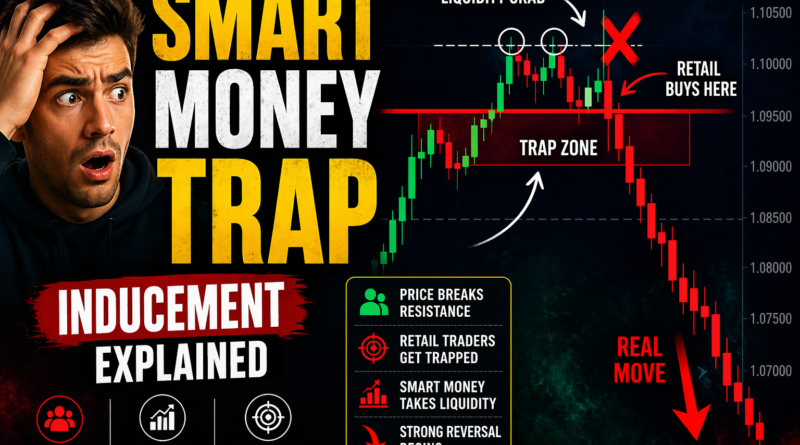
Inducement in Trading: How Smart Money Traps Retail Traders (Simple Price Action Guide)
Most traders believe the market moves randomly. In reality, it does not.
Price movement is not always about direction alone, it is about liquidity. Markets need orders to move, and those orders often come from retail traders entering at the wrong time.
This is where a key concept in Smart Money Concepts (SMC) comes in: inducement.
If you do not understand inducement, you will often enter trades that look perfect only to watch price reverse immediately after.
This guide explains inducement in a clear, practical way so you can start recognizing traps and improving your timing.
What Is Inducement in Trading?
Inducement is when price is deliberately moved in a way that attracts traders into positions—only to reverse afterward.
In simple terms: Inducement = a setup that looks real, but is designed to trap traders.
It is not random. It is part of how the market creates liquidity.
You will often see inducement as:
- A breakout that fails quickly
- A strong support or resistance reaction that suddenly reverses
- A structure break that looks like confirmation, but is actually false
At that moment, everything looks valid. That is exactly why it works as a trap. How to Pass Funded Trading Challenges Step-by-Step
Why Inducement Happens
To understand inducement, you need to understand how large players operate.
Big institutions cannot enter the market easily. They need liquidity meaning other traders on the opposite side of their trade.
For example:
- If institutions want to buy → they need sellers
- If they want to sell → they need buyers
But at key levels, liquidity is often not enough.
So the market creates it.
It does this by:
- Pushing price slightly beyond key levels
- Triggering breakout traders
- Hitting stop losses from existing positions
- Creating false confidence in direction
Once enough traders are trapped, the market has the liquidity it needs and then it moves strongly in the real direction. Funded Forex Accounts: A Professional Guide to Prop Trading in 2026 (Institutional-Level Breakdown)
What Inducement Looks Like on the Chart
Once you understand inducement, you will start noticing repeatable patterns.
1. Fake Breakouts
Price breaks a clear support or resistance level.
Traders enter thinking the move is real.
But shortly after:
- Price moves back inside the range
- Breakout traders are trapped
- The real move has not started yet
This is one of the most common inducement patterns.
2. Early “Confirmation” That Fails
Sometimes price gives a small structure break or weak confirmation.
Traders interpret it as a valid entry signal.
But what happens next:
- Price reverses
- Liquidity is taken
- Then the real move starts later
The early signal was not confirmation it was inducement. Best Time to Trade XAUUSD (Gold) for Maximum Volatility
3. Equal Highs and Lows (Liquidity Pools)
You will often see price forming equal highs or equal lows.
This creates a predictable setup:
- Traders expect a breakout
- They place buy stops or sell stops
- Price sweeps those levels
- Then reverses sharply
These equal highs/lows are classic liquidity targets.
4. Choppy Consolidation Before a Trap
Another common scenario:
- Price moves sideways
- Multiple small fake signals appear
- Traders get confused and enter early
- Market continues to range or sweep liquidity
- Then a strong directional move appears
This phase is designed to create impatience and emotional entries.
The Biggest Mistake Traders Make
Most traders lose money for one simple reason: They trade the first signal they see.
That includes:
- First breakout
- First retest
- First structure shift
But in many cases, the first signal is not the real move it is inducement.
The market often gives an “early setup” on purpose to attract liquidity.
If a setup looks too clean or too obvious, it often requires extra caution. London Session Strategy: How to Catch the Real Move Without Getting Trapped
How to Avoid Inducement Traps
You cannot avoid inducement completely, but you can filter it effectively.
1. Stop Entering the First Move
One of the most powerful mindset shifts in trading is this:
Do not trade the initial breakout.
Instead:
- Let the breakout happen
- Let liquidity get taken
- Wait for reaction and confirmation
Missing the first move is often safer than entering a trap.
2. Always Ask: Has Liquidity Been Taken?
Before entering any trade, ask: “Has price taken liquidity yet?”
Look for:
- Equal highs or lows being swept
- Previous swing highs/lows being broken
- Stop-loss clusters being triggered
If liquidity has not been taken, the market may still be building toward it.
3. Wait for Strong Displacement
The real move usually starts after inducement with strong momentum.
Look for:
- Large impulsive candles
- Clean directional movement
- Break of structure with strength
- Clear imbalance in price action
Weak movement is not confirmation. It is uncertainty. How to Trade Break and Retest Without Getting Faked Out (Simple Price Action Guide)
4. Use Higher Timeframe Direction
Inducement often goes against the real trend.
For example:
- Lower timeframe shows bullish breakout
- Higher timeframe is strongly bearish
In this case, the breakout is likely inducement, not a reversal.
Always align with the higher timeframe trend before trusting a setup.
Simple Example of Inducement in Action
Let’s break it down clearly:
- Price is trading below resistance
- Price pushes upward and breaks resistance
- Traders enter buy positions (thinking breakout is real)
- Stops from sellers above resistance are triggered
- Liquidity is collected
- Price reverses sharply downward
- Breakout buyers are trapped
In this case:
- The breakout was not the move
- It was the trap before the real move
The Mindset Shift You Need
To trade inducement correctly, you need a different way of thinking.
Most traders ask: Where should I enter?
Smart traders ask: Where are other traders likely entering and how can that liquidity be used?
This shift is important.
You stop reacting to candles and start understanding behavior behind price movement. Premium vs Discount Zones Explained: A Practical Guide to Market Value in Forex (SMC Concept)
Final Thoughts
Inducement is not a complex theory. It is simply how the market creates liquidity before moving.
Once you start recognizing it, your trading changes:
- You stop chasing early moves
- You avoid obvious traps
- You wait for confirmation instead of guessing
- You improve timing naturally
You do not need to catch every move in the market.
You only need to avoid the false ones.
And in trading, avoiding losses from traps is often more powerful than finding new entries.
Disclaimer
Disclaimer: Trading forex and CFDs involves significant risk and may not be suitable for all investors. This article is for educational purposes only and should not be considered financial advice.
Written by Shah – Forex trader and market analyst at Forex News 360.
This is best for new traders :

Pingback: Premium and Discount Zones Forex Explained: Complete Smart Money (SMC) Guide
Pingback: Market Structure Scalping Strategy (1M–5M Price Action Guide)