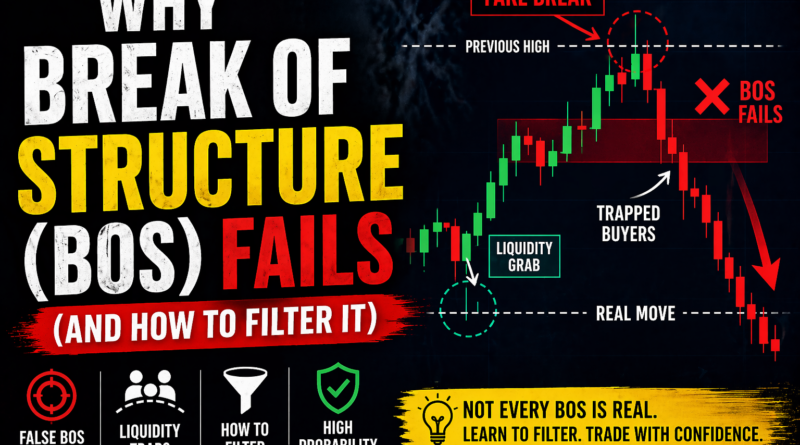
Why Break of Structure (BOS) Fails (And How to Filter It)
If you’ve been trading SMC or price action for a while, you’ve probably experienced this:
Price breaks structure → you enter → market instantly reverses.
It’s frustrating because on paper, you did everything right. The structure broke. The setup was clean. But still… it failed.
The truth is, not every BOS is real. A lot of them are just noise or worse, traps.
Let’s break down why that happens and how to stop getting caught in it.
What BOS Is Supposed to Mean
In theory, a Break of Structure means a shift in market direction.
- Higher high broken → bullish continuation
- Lower low broken → bearish continuation
Simple, right?
But the market doesn’t move in a textbook way.
A “break” alone doesn’t mean control has shifted.
That’s where most traders get it wrong.
Why BOS Fails (The Real Reasons)
1. No Real Displacement
This is the biggest one.
Price breaks a level… but does it slowly, with weak candles, wicks everywhere, no momentum.
That’s not a real break. That’s just price drifting.
A valid move usually has:
- Strong impulsive candles
- Clean body closes
- Imbalance left behind (FVG)
No displacement = no conviction.
2. It Happens Into Higher Timeframe Levels
You might see a clean BOS on the 5m or 15m…
But zoom out, and price is hitting a major supply or demand zone.
So what happens?
- Lower timeframe shows breakout
- Higher timeframe says “nope”
- Price reverses hard
This is why context matters more than the signal itself.
3. Liquidity Wasn’t Taken Yet
Before a real move, the market usually grabs liquidity.
If price breaks structure without sweeping highs/lows first, it’s often incomplete.
That “BOS” becomes inducement:
- Traders enter early
- Stops build up
- Market reverses to grab them
Then the real move starts.
4. It’s an Inducement Move
Sometimes the BOS is the trap.
Price breaks structure just enough to:
- Trigger breakout traders
- Confirm bias for retail
- Create liquidity
Then reverses.
This is why blindly trading every BOS is dangerous.
5. Choppy / Range Conditions
Inside a range, structure breaks are unreliable.
You’ll see:
- BOS up → fail
- BOS down → fail
- Repeat
That’s not trend, that’s noise.
If the market is not trending, BOS loses meaning.
How to Filter a Good BOS
Now the important part, how do you avoid the bad ones?
1. Wait for Displacement
Don’t react to the break. React to how it breaks.
Ask:
- Was it aggressive?
- Did it leave imbalance?
- Did it look like intent?
If it’s weak, skip it.
2. Check Higher Timeframe Context
Before trusting any BOS:
- Where is price on HTF?
- Is it near supply/demand?
- Are we in premium or discount?
A good setup on the wrong location is still a bad trade.
3. Look for Liquidity Sweep First
The best setups often follow this sequence:
Liquidity grab → displacement → BOS → continuation
If the sweep hasn’t happened yet, patience pays.
4. Avoid Trading Inside Ranges
If price is chopping:
- Don’t trust structure breaks
- Focus on range highs/lows instead
BOS works best in clear trends.
5. Combine With FVG or Key Zones
A strong BOS usually aligns with:
- Fair Value Gap
- Order block / supply-demand
- Previous structure zones
That’s real confluence, not random confirmation.
Simple Example (What a Trap Looks Like)
- Price breaks above a recent high
- Looks like bullish BOS
- Traders buy
But:
- No strong momentum
- No liquidity sweep before
- Sitting near HTF resistance
Result?
Price drops → buyers trapped → move goes the other way.
The Mindset Shift
Instead of asking:
“Did structure break?”
Start asking:
“Was this break meaningful?”
That one question filters a lot of bad trades.
Final Thoughts
BOS isn’t useless, it’s just misunderstood.
On its own, it’s weak.
But when combined with:
- Liquidity
- Displacement
- Context
It becomes powerful.
You don’t need to catch every break.
You just need to avoid the fake ones.
Because in this market…
The obvious move is often the wrong one.