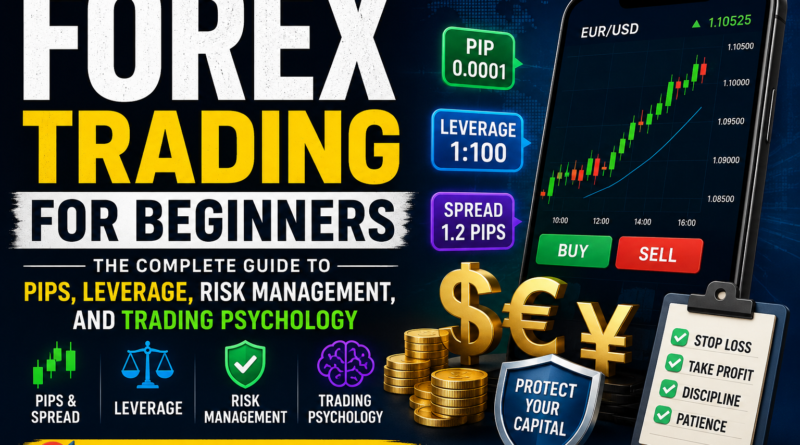
Forex Trading for Beginners: Complete Guide to Pips, Leverage, Risk Management, and Trading Psychology
forex trading for beginners: The global Forex market can feel like a bustling, high-stakes digital bazaar. With over $7 trillion traded daily, it is the largest financial market in the world.
If you are a beginner looking to get a piece of the action, you have probably run into a wall of confusing jargon: pips, leverage, margins, and London sessions. It sounds like a completely different language.
Don’t worry. This guide is your ultimate roadmap. We will break down complex Forex terms into plain, simple English with real-life examples. Whether you want a solid side income or a new full-time career, mastering these fundamentals is your first step. Let’s dive in!
Section 1: The Building Blocks of Forex (Pips and Spreads)
Before you place your first trade, you need to understand how the market measures price movements and how your broker charges you.
What Is a Pip in Forex?
In the real world, we measure distance in miles or kilometers. In the Forex world, we measure price movement in Pips.
Definition: “Pip” stands for Percentage in Point or Price Interest Point. It represents the smallest standard price change that a currency pair can make.
For most currency pairs (like the EUR/USD), a pip is the fourth decimal place ($0.0001$).
Real-Life Example
Imagine the EUR/USD currency pair is currently priced at 1.1000.
- If the price moves up to 1.1001, it has increased by 1 pip.
- If the price drops to 1.0990, it has decreased by 10 pips.
The Exception (Japanese Yen): Pairs involving the Japanese Yen (JPY) only have two decimal places. For example, if the USD/JPY moves from 150.00 to 150.01, that is a 1-pip move.
What Is Spread in Forex?
When you travel to another country and swap your cash at the airport, you will notice the bank buys currency from you at a lower price than they sell it to you. That difference is how they make money. In online trading, this gap is called the Spread.
The spread is the difference between the Bid price (the price to sell) and the Ask price (the price to buy).
Real-Life Example
You look at your trading app, and the GBP/USD pair shows:
- Bid (Sell): 1.2500
- Ask (Buy): 1.2502
The difference between 1.2502 and 1.2500 is 2 pips. This 2-pip difference is the spread. The moment you open a trade, you start slightly in the negative by the amount of the spread because that goes straight to your broker as a fee. Check out Moving Averages (EMA vs SMA): Complete Beginner Guide for Forex, Gold & Crypto Traders
| Term | Simple Definition | Example |
| Pip | The 4th decimal digit tracking price movement | 1.1000 to 1.1001 (1 Pip) |
| Spread | The broker’s fee; the gap between buy and sell price | Buy at 1.2502, Sell at 1.2500 (2 Pip Spread) |
Section 2: The Double-Edged Sword (Leverage Explained)
What Is Leverage in Trading?
Forex prices move by tiny fractions of a cent (pips). If you only trade with $100 of your own money, a 50-pip move might only make you a few cents. To make meaningful profits, you need to trade larger amounts. This is where Leverage comes in.
Leverage is essentially a temporary loan given to you by your broker. It allows you to control a large amount of money while only putting down a tiny deposit (known as Margin).
Leverage is usually expressed as a ratio, such as 1:10, 1:100, or 1:500.
Real-Life Example
Imagine you want to buy a house worth $100,000. The bank tells you that you only need a down payment of $1,000 to buy it, and they will cover the rest. This is 1:100 leverage.
In Forex, if you use 1:100 leverage:
- You can control a $100,000 position with just $1,000 of your own money.
- If the trade goes your way by 1%, you make a $1,000 profit (doubling your capital!).
- The Danger: If the trade goes against you by just 1%, you lose your entire $1,000 investment instantly.
Key Takeaway: Leverage multiplies both your potential profits and your potential losses. Use it with extreme caution.
Section 3: Timing the Market (Forex Trading Sessions)
Unlike the stock market, which opens and closes at specific times of the day, the Forex market is open 24 hours a day, 5 days a week (from Sunday night to Friday night).
Because the world has different time zones, the market moves through four major trading sessions. See Smart Money Concepts (SMC) Explained: Order Blocks, Liquidity & Strategy
Best Trading Sessions Explained
The four main sessions are:
- The Sydney Session (Pacific)
- The Tokyo Session (Asian)
- The London Session (European)
- The New York Session (American)
While you can trade at any time, the best time to trade is when the market is highly active. This happens when two sessions overlap, resulting in more buyers and sellers in the market.
[Tokyo Session]
       \__ Overlap __/
              [London Session]
                     \__ Overlap (Peak Volume!) __/
                            [New York Session]
- The London/New York Overlap: This occurs roughly between 8:00 AM EST and 12:00 PM EST. This is widely considered the best time to trade because the two biggest financial centers in the world are active at the same time. The market moves fast, and spreads are at their lowest.
- The Asian Session: Usually quieter and slower. It is excellent for trading pairs involving the Japanese Yen (JPY) or Australian Dollar (AUD), but can be frustratingly slow for EUR or USD pairs.
Section 4: Protecting Your Capital (Risk Management)
Many beginners enter Forex thinking about how much money they can make. Professional traders enter Forex thinking about how much money they can afford to lose. This shift in mindset is called Risk Management.
What Is Stop Loss and Take Profit?
These are automated instructions you set inside your trading platform to close your trade without you having to look at your screen.
- Stop Loss (SL): This is your safety net. You tell your broker, “If the market drops to this specific price, close my trade immediately because I was wrong.” It protects you from losing all your account balance on a single bad trade.
- Take Profit (TP): This is your target. You tell your broker, “If the price reaches this high point, close the trade and lock in my profits before the market reverses.”
Do you know about : Break of Structure vs Change of Character (BOS vs CHoCH) – Smart Money Concepts Guide
Real-Life Example
You buy the EUR/USD at 1.1000. You want to make money if it goes up, but you don’t want to lose too much if it drops.
- You set a Stop Loss at 1.0950 (Risking 50 pips).
- You set a Take Profit at 1.1100 (Aiming for 100 pips).
If the market drops to 1.0950, your trade closes automatically, and you walk away with a small, calculated loss. You live to fight another day.
How Risk Management Works
The gold standard rule for beginner traders is the 1% Rule.
The 1% Rule: Never risk more than 1% of your total trading account balance on a single trade.
If you have a $10,000 trading account, 1% is $100. This means your Stop Loss should be configured so that if it gets hit, you lose no more than $100. By following this rule, you would have to lose 100 trades in a row to wipe out your account.
Section 5: The Mental Game (Trading Psychology)
You can have the best technical trading strategy in the world, but if your mind isn’t right, you will lose money. Forex trading is 20% strategy and 80% psychology.
Why Traders Lose Money
Statistics show that roughly 70% to 90% of retail Forex traders lose money. Why? It isn’t because they don’t understand charts. It is because they fall victim to human biology and emotions.
Emotional Trading Mistakes: Fear and Greed
The market is a giant mirror that reflects your deepest emotional flaws. Two primary emotions drive the market:
- Greed: This happens when you win a few trades and start feeling invincible. You increase your lot sizes, use massive leverage, and break your rules to chase bigger returns. Greed usually ends with a margin call (wiping out your account).
- Fear: This happens after a string of losses. You become terrified of losing more money, so you hesitate to take a perfectly valid trade setup. Alternatively, you might close a winning trade way too early because you are scared the market will turn around and steal your tiny profit.
This is important: Why Break of Structure (BOS) Fails and How to Filter It (SMC Price Action Guide)
Overtrading and Revenge Trading Mistakes
Two of the most dangerous behavioral traps are overtrading and revenge trading:
- Overtrading Explained: This is treating the market like a casino slot machine. Overtrading happens when you open dozens of trades a day out of pure boredom or excitement, even when there are no good setups on the charts. Remember, sitting on your hands and doing nothing is an active trading decision that saves you capital.
- Revenge Trading Mistakes: Imagine you lose a trade and feel angry or insulted by the market. To “get your money back,” you immediately enter another trade with double the size without any logical analysis. This is revenge trading, and it is a fast track to emotional and financial bankruptcy.
[Lose a Trade] ──> [Feel Angry] ──> [Revenge Trade (Double Size)] ──> [Lose Bigger] ──> [Despair]
How to Build Trading Discipline and Patience
Discipline isn’t something you are born with; it is a habit you build. Here is how you build trading discipline:
- Write a Trading Plan: Document exactly what setup you look for, what time you will trade, and how much you will risk before you open your laptop.
- Keep a Trading Journal: Take a screenshot of every trade you make. Write down why you took it and how you felt. Review it every weekend.
- Practice Patience: Treat Forex like a predatory animal hunting prey. A lion doesn’t run after every single rabbit; it waits patiently in the bushes for the perfect target. Wait for your strategy’s exact conditions to be met before pulling the trigger.
Key Takeaways
- Pips measure price movement, while Spreads represent the cost of trading paid to your broker.
- Leverage increases your buying power, but it acts as a accelerator for both profits and losses.
- The best market activity occurs during trading session overlaps, particularly the London and New York overlap.
- Always use a Stop Loss and never risk more than 1% of your capital per trade.
- Control Fear and Greed by sticking strictly to a written trading plan and avoiding the temptation of revenge trading.
Frequently Asked Questions (FAQ)
1. How much money do I need to start Forex trading?
You can start with as little as $10 to $100 using a “micro account” or “cent account.” However, to practice realistic risk management, starting with $500 to $1,000 is generally recommended.
2. Can I practice trading without risking real money?
Yes. Every reputable Forex broker offers a Demo Account. This lets you trade in real market conditions using fake virtual money. Beginners should spend at least 2–3 months consistently profitable on a demo account before risking real cash.
3. What is the difference between Forex and Stock trading?
The stock market involves buying shares of specific companies (like Apple or Tesla) and is limited to specific exchange operating hours. The Forex market involves trading national currencies against one another and operates continuously 24 hours a day during weekdays.
4. How long does it take to become a successful Forex trader?
There is no shortcut. For most people, it takes 1 to 3 years of consistent study, practice, and emotional conditioning to become independently profitable.
5. Why is a Stop Loss so important?
A Stop Loss ensures that a single bad market event or mistake does not wipe out your entire account balance. It keeps you in the game for the long run.
Do you know about order block: Order Block Entry Strategy: Step-by-Step Guide (Real Trader Approach)
Conclusion
Forex trading is not a get-rich-quick scheme. It is a high-income skill that requires patience, mechanical precision, and immense emotional discipline.
By mastering the foundational mechanics of pips and sessions, prioritizing risk management above profits, and keeping your emotions under wraps, you are already ahead of the vast majority of amateur traders.
What is your biggest challenge as a beginner trader right now? Is it understanding the math behind pips, or controlling the urge to overtrade? Let us know in the comments below!
Written by Shah – Forex trader and market analyst at Forex News 360.
This is best for new traders :

Pingback: Why Most Beginner Traders Lose Money in Forex Trading (And How to Avoid It)
Pingback: Mastering Order Block Entry Strategy: A Trader's Guide