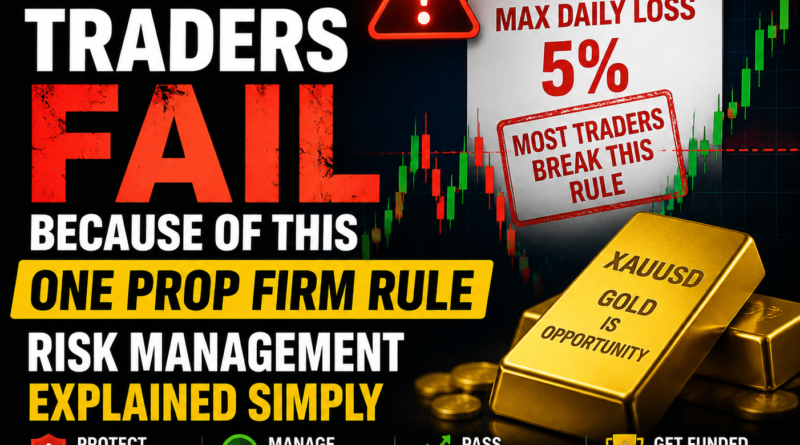
Why 90% of Traders Fail Prop Firm Challenges (Risk Management Explained)
Passing a prop firm challenge is not only about finding the perfect trading strategy. In reality, many traders already have decent entries, solid technical analysis skills, and a basic understanding of the market. The real reason most traders fail is much simpler: poor risk management.
Many traders enter funded challenges believing they need a “secret strategy” to pass. They spend weeks searching for indicators, signals, and advanced trading systems while ignoring the one thing prop firms care about the most protecting capital.
The truth is that prop firms are designed to reward disciplined traders, not gamblers.
If you cannot manage risk consistently, even a profitable strategy will eventually fail.
In this guide, we’ll explain the most important prop firm rule in simple terms and show how proper risk management can dramatically improve your chances of passing a funded challenge.
Why Most Traders Fail Prop Firm Challenges
Most failed accounts follow the same pattern.
A trader starts with confidence, wins a few trades, then becomes overconfident. After a loss, emotions take over. Risk increases, discipline disappears, and the account slowly moves closer to the drawdown limit.
This happens far more often than traders realize.
The common mistakes include:
- Risking too much on one trade
- Ignoring daily drawdown limits
- Revenge trading after losses
- Over-leveraging positions
- Removing stop-loss orders
- Trying to recover losses quickly
These mistakes are not strategy problems. They are risk management problems.
Many traders could actually become profitable if they simply learned how to survive long enough in the market : How to Trade Break and Retest Without Getting Faked Out (Simple Price Action Guide)
The One Rule Every Prop Trader Must Understand
The most important rule is simple: Never risk more than your account can realistically recover from.
Prop firms want traders who can protect capital during difficult market conditions. They are not searching for traders who double accounts overnight.
A trader who makes slow, controlled progress is far more valuable than someone taking aggressive trades with huge drawdowns.
That is why understanding drawdown limits is critical before placing any trade.
Step 1: Understand Daily and Maximum Drawdown Limits
Every prop firm challenge includes two important rules:
Daily Loss Limit
This is the maximum amount you can lose in a single trading day.
For example:
- If your account has a 5% daily drawdown limit, losing more than 5% in one day could instantly fail the challenge.
Maximum Drawdown
This is the total loss allowed on the account overall.
For example:
- A 10% maximum drawdown means your account cannot drop below that limit at any point during the challenge.
Many traders ignore these numbers until it is too late.
Before opening any position, always ask yourself:
- How much am I risking?
- How close am I to my drawdown limit?
- Can this trade damage my challenge account?
Professional traders think about protection first and profits second, Why Break of Structure (BOS) Fails and How to Filter It (SMC Price Action Guide)
Step 2: Use Proper Risk Per Trade
One of the biggest mistakes traders make is risking too much on a single setup.
Even if the trade looks perfect, risking large amounts creates emotional pressure and increases the chance of violating prop firm rules.
For most funded challenges, professional traders usually risk:
- 0.5% to 1% per trade
This keeps losses manageable and allows multiple opportunities without destroying the account.
For example:
If you risk 1% per trade:
- You could lose several trades in a row and still remain safely inside the challenge rules.
But if you risk 5% per trade:
- Two losing trades could end the account completely.
This is why position sizing matters more than finding the “perfect entry.”
Why Stop-Loss Orders Matter
A stop-loss is not a weakness. It is protection.
Many beginners remove stop-loss orders because they believe the market will reverse in their favor. Sometimes it does, but eventually one uncontrolled trade can wipe out weeks of progress.
Using proper stop-loss placement helps traders:
- control emotions
- define risk clearly
- avoid catastrophic losses
- maintain consistency
The goal is not to avoid losses completely. The goal is to keep losses small enough to survive.
Step 3: Avoid Emotional Trading
Emotional trading destroys more prop firm accounts than bad analysis.
After a losing trade, many traders immediately try to “win the money back.” This often leads to:
- revenge trading
- oversized positions
- impulsive entries
- breaking trading plans
The market rewards discipline, not emotional reactions.
One important habit is learning to step away after a bad trade or losing streak. Professional traders understand that protecting mental clarity is just as important as protecting capital.
Consistency comes from following rules repeatedly, even during stressful market conditions.
This is important: Internal vs External Liquidity Explained (With Real Trading Examples)
Step 4: Keep a Trading Journal
Most losing traders never review their own behavior.
A trading journal helps identify:
- recurring mistakes
- emotional decisions
- overtrading habits
- strong setups
- weak setups
Your journal should include:
- entry price
- exit price
- stop-loss
- take-profit
- percentage risk
- reason for entering the trade
- emotional state during the trade
Over time, this data becomes extremely valuable.
Many traders discover that their biggest problems are psychological, not technical.
Step 5: Apply Risk Management to XAUUSD Trading
Gold (XAUUSD) is one of the most popular markets among prop firm traders because of its strong volatility and large price movements.
However, that same volatility can become dangerous without proper risk management.
When trading XAUUSD:
- avoid oversized positions
- trade during liquid market sessions
- use realistic stop-loss levels
- never chase fast-moving candles
Gold can move aggressively during:
- CPI releases
- Federal Reserve announcements
- geopolitical events
- Non-Farm Payroll data
This is why discipline matters even more when trading XAUUSD.
A strong strategy combined with controlled risk gives traders a much higher chance of surviving funded challenges, High Value SMC & Price Action Concepts (Next-Level Trading Guide)
The Real Goal of Prop Firm Trading
Many traders focus only on passing the challenge.
But long-term success comes from becoming consistently disciplined.
Prop firms are not searching for lucky traders. They want traders who can:
- follow rules
- manage losses
- remain calm under pressure
- protect capital consistently
That mindset separates the 10% who succeed from the majority who fail.
This is SMC: Smart Money Concepts (SMC) Explained: Order Blocks, Liquidity & Strategy
Frequently Asked Questions (FAQ)
What is the biggest reason traders fail prop firm challenges?
The biggest reason is poor risk management. Many traders risk too much on individual trades, ignore drawdown limits, or make emotional decisions after losses. Even a profitable strategy can fail if risk is not controlled properly.
How much should I risk per trade in a prop firm challenge?
Most experienced traders risk between 0.5% and 1% per trade. This helps protect the account during losing streaks and keeps traders within the prop firm’s drawdown rules.
What is a daily drawdown limit?
A daily drawdown limit is the maximum amount a trader can lose in one trading day before violating challenge rules. If the limit is exceeded, the account may be disqualified.
What is maximum drawdown in prop firm trading?
Maximum drawdown is the total loss allowed on the account overall. For example, if a prop firm allows a 10% maximum drawdown, the account balance cannot fall below that limit at any time.
Why is risk management more important than strategy?
A strong strategy cannot survive poor risk management. Traders who over-leverage or ignore stop-loss protection can fail quickly, even if their market analysis is correct. Proper risk management helps traders stay consistent long enough for their strategy to work over time.
Should beginners trade XAUUSD during prop firm challenges?
Beginners can trade XAUUSD, but they should be careful because gold is highly volatile. It is important to use smaller position sizes, proper stop-loss levels, and disciplined risk management when trading gold.
How can a trading journal improve consistency?
A trading journal helps traders track mistakes, emotional decisions, and successful setups. Reviewing trades regularly allows traders to improve discipline and refine their strategy over time.
Can emotional trading cause challenge failure?
Yes. Emotional trading is one of the most common reasons traders fail funded challenges. Revenge trading, fear, greed, and overconfidence often lead to breaking risk management rules.
What is the safest trading style for prop firm challenges?
Many traders prefer disciplined swing trading or structured intraday trading with controlled risk. The safest approach is one that focuses on consistency, patience, and proper capital protection rather than aggressive profits.
Is passing a prop firm challenge possible for beginners?
Yes, but beginners should focus on learning risk management, controlling emotions, and following a consistent trading plan. Passing a challenge usually requires patience and discipline more than aggressive trading.
Conclusion
Most traders do not fail prop firm challenges because their strategies are bad. They fail because they ignore proper risk management.
Understanding drawdown rules, controlling risk per trade, using stop-loss protection, and staying emotionally disciplined can completely change trading performance over time.
A trader who protects capital always has another opportunity to trade tomorrow. That is the foundation of long-term success in funded trading.
Written by Shah – Forex trader and market analyst at Forex News 360.
Learn more and explore the full step-by-step XAUUSD strategy guide here: https://forexnews360.com/free-guide/pass-funded-challenges-xauusd-forex-guide/
This is best for new traders :

Pingback: New York Session Trading Guide for Forex & Gold (Best Entry Timing Strategy)
Pingback: Mastering Order Block Entry Strategy: A Trader's Guide
Pingback: Institutional Trading in Forex: Beginner’s Guide to How Banks Move the Market