
Why Consistency Matters More Than Big Wins in Trading
Why consistency matters more than big wins in trading is one of the most important lessons every beginner trader must understand. Many traders enter the forex market hoping to make huge profits quickly, but professional traders know that steady growth, proper risk management, and disciplined trading are the real keys to long-term success.
In this guide, you will learn why consistency is more valuable than one lucky trade, how emotional trading destroys accounts, and the practical habits that successful traders use to grow their accounts safely over time.
The Biggest Misunderstanding About Trading
Most beginners think trading is about:
- Finding the “perfect” trade
- Doubling money quickly
- Taking huge risks
- Catching every market move
This mindset creates emotional trading.
When traders lose, they try to recover fast. When they win, they become overconfident. Both situations usually lead to poor decisions.
Real trading success comes from:
- Managing risk
- Following a strategy
- Protecting capital
- Staying disciplined
- Repeating good habits
Trading is more like running a business than gambling. Forex Risk Management: A Simple Guide to Protecting Your Money
Why Big Wins Can Be Dangerous
Big wins sound amazing, but they can actually hurt beginner traders.
Here’s why.
1. Overconfidence Starts Growing
Suppose a beginner trader turns $100 into $500 in one trade.
Instead of learning discipline, they may think: “I figured out the market.”
Now they start:
- Increasing lot sizes
- Ignoring stop losses
- Taking random entries
- Trading emotionally
One bad trade can wipe out everything.
2. Big Wins Create Unrealistic Expectations
After a huge profit, traders expect the same result daily.
But markets do not move the same way every day.
When profits become smaller, frustration begins. Many traders then force trades just to chase large gains again.
This usually ends badly.
3. Risk Becomes Too High
To achieve massive profits quickly, traders often risk too much.
For example:
| Account Size | Risk Per Trade |
|---|---|
| $100 | $50 |
| $500 | $250 |
This is extremely dangerous.
A few losing trades can destroy the account completely.
Professional traders usually risk only 1%–2% per trade. Why Most Beginner Traders Lose Money in Forex Trading
Why Consistency Wins in the Long Run
Consistency may look boring, but it creates stability.
Let’s compare two traders.
Trader A
- Makes 100% profit in one week
- Loses 80% next week
- Keeps changing strategy
Trader B
- Makes 3%–5% monthly
- Uses proper risk management
- Protects capital carefully
After one year, Trader B is usually in a much stronger position.
Why?
Because consistency allows:
- Steady account growth
- Emotional control
- Better decision-making
- Long-term survival
Small Wins Compound Over Time
One of the most powerful concepts in trading is compounding.
Even small gains can grow significantly over time.
For example:
If you grow your account by just 5% monthly:
| Month | Balance |
|---|---|
| Start | $1,000 |
| 3 Months | $1,157 |
| 6 Months | $1,340 |
| 12 Months | $1,795 |
This may not look exciting at first, but the growth becomes powerful over time.
Many traders fail because they want fast money instead of steady growth.
You can also read our guide on:
- Risk management strategies
- Trading psychology basics
- Beginner forex mistakes
The Role of Discipline in Consistent Trading
Consistency comes from discipline.
Not from luck.
A disciplined trader:
- Waits for quality setups
- Uses stop losses
- Follows a trading plan
- Accepts losses calmly
- Avoids revenge trading
Without discipline, even the best strategy can fail.
Example: Two Different Trading Styles
Aggressive Trader
- Risks 20% on one trade
- Trades without confirmation
- Chases the market
- Focuses only on profit
Result:
- Huge emotional pressure
- Big account swings
- Higher chance of blowing account
Consistent Trader
- Risks 1%–2%
- Waits patiently
- Follows strategy
- Focuses on process
Result:
- Stable mindset
- Controlled losses
- Long-term survival
The second trader may look slower, but this is how professionals trade. Institutional Trading Report: Why Your Strategy Works on Paper but Fails in Live Execution
Why Professional Traders Focus on Survival
One important truth: Your first goal in trading is survival.
If your account is destroyed, you cannot continue trading.
Professional traders understand this very well.
They know:
- Losses are normal
- Winning every trade is impossible
- Protecting capital matters most
Many beginners focus only on profits.
Professionals focus on:
- Risk management
- Consistency
- Emotional control
This difference changes everything.
The Emotional Side of Trading
Trading is not only technical. It is psychological.
Big wins create excitement.
Big losses create fear.
Both emotions can affect decision-making.
Consistent traders learn to stay calm during:
- Winning streaks
- Losing streaks
- Slow market conditions
This emotional balance is extremely important.
Screenshot Example Ideas for Your Article
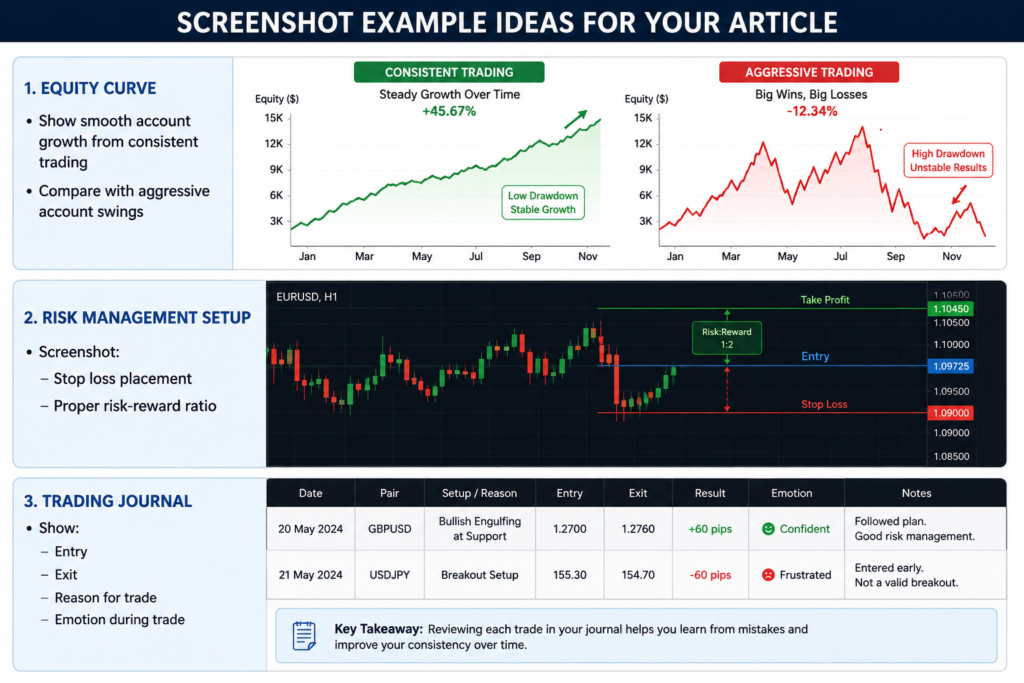
Example 1: Equity Curve
Show:
- Smooth account growth from consistent trading
- Compare with aggressive account swings
Example 2: Risk Management Setup
Screenshot:
- Stop loss placement
- Proper risk-reward ratio
Example 3: Trading Journal
Show:
- Entry
- Exit
- Reason for trade
- Emotion during trade
These visuals make the article more engaging for readers.
Common Mistakes Traders Make
1. Chasing Fast Money
Many traders enter trading expecting instant profits.
This mindset causes:
- Overtrading
- Emotional decisions
- High risk-taking
Trading requires patience.
2. Increasing Lot Size After Winning
After a few successful trades, beginners often increase position size too quickly.
This usually leads to:
- Emotional pressure
- Fear during pullbacks
- Larger losses
3. Ignoring Stop Losses
Some traders remove stop losses because they “believe” the market will return.
This can become disastrous.
Always protect your account first.
4. Strategy Hopping
Many traders keep changing strategies every week.
They never give one system enough time to work properly.
Consistency requires sticking to one tested approach.
5. Revenge Trading
After a loss, traders try to recover quickly by taking random trades.
This often creates bigger losses.
Losses are normal in trading.
Building a Consistent Trading Routine
Here are practical ways to become more consistent.
1. Create a Trading Plan
Your plan should include:
- Entry rules
- Exit rules
- Risk percentage
- Trading sessions
- Maximum daily loss
A written plan reduces emotional decisions.
2. Use Proper Risk Management
Never risk large amounts on one trade.
Most professionals risk:
- 1%
- 2% maximum
This helps protect your account during losing streaks.
3. Keep a Trading Journal
Write down:
- Why you entered
- Why you exited
- Emotional state
- What worked
- What failed
This helps improve your decision-making over time.
4. Focus on Process, Not Profit
Instead of asking: “How much money did I make?”
Ask: “Did I follow my strategy correctly?”
Good process leads to better long-term results.
5. Avoid Overtrading
You do not need to trade every day.
Sometimes the best trade is no trade.
Waiting for quality setups improves consistency.
Realistic Expectations in Trading
One major problem among beginners is unrealistic expectations.
Social media often shows:
- Luxury lifestyles
- Huge profits
- Fast success
But rarely shows:
- Losses
- Stress
- Years of learning
Real trading success takes time.
Learning patience can save your account and your mindset. How to Pass Funded Trading Challenges Step-by-Step
Consistency Builds Confidence
Confidence should come from:
- Following your rules
- Managing risk correctly
- Staying disciplined
Not from lucky trades.
Consistent habits create real confidence because you trust your process.
Trading Is a Marathon, Not a Sprint
Many traders treat trading like a race.
They want:
- Fast profits
- Quick success
- Instant results
But professional trading is long-term.
A trader who survives for years usually outperforms traders chasing quick money.
Slow growth is still growth.
FAQs
Can small profits really grow an account?
Yes.
Small consistent gains combined with proper risk management and compounding can grow an account steadily over time.
Is it possible to win every trade?
No.
Even professional traders lose trades regularly.
The goal is not winning every trade. The goal is managing losses and staying profitable overall.
What is a safe risk percentage per trade?
Most experienced traders risk around 1%–2% per trade.
This protects the account during losing streaks.
Why do beginners fail in trading?
Common reasons include:
- Overtrading
- Poor risk management
- Emotional decisions
- Unrealistic expectations
- Lack of discipline
How long does it take to become consistent?
It depends on the trader.
For many people, consistency takes months or even years of practice, learning, and discipline.
Should I focus more on strategy or psychology?
Both matter.
Even a good strategy can fail if emotions are not controlled properly.
Final Thoughts
Big wins may look exciting, but consistency is what creates long-term trading success.
A trader who protects capital, manages risk, and follows a disciplined process has a much higher chance of surviving and growing steadily.
Trading is not about proving how smart you are in one trade.
It is about making good decisions repeatedly over time.
Focus on:
- Discipline
- Patience
- Risk management
- Emotional control
- Consistent execution
That is what separates professional traders from gamblers.
Action Steps for Beginners
Start applying these habits today:
- Risk only 1%–2% per trade
- Stop chasing fast profits
- Create a trading plan
- Keep a trading journal
- Focus on consistency, not excitement
- Review your mistakes weekly
- Practice emotional discipline
Small improvements repeated consistently can create powerful long-term results in trading.
This educational article was created for beginner traders who want to understand candlestick charts in a simple and practical way. The content is based on commonly used technical analysis principles widely discussed in forex education and trading communities.
Disclaimer: Trading forex and CFDs involves significant risk and may not be suitable for all investors. This article is for educational purposes only and should not be considered financial advice.
