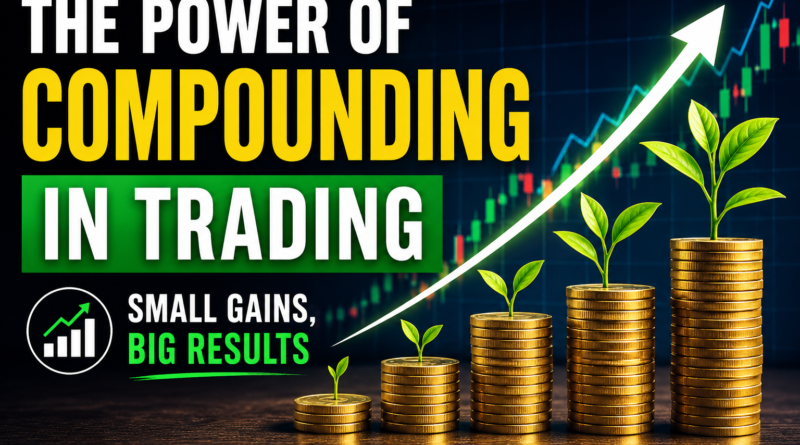
The Power of Compounding in Trading: How Small Gains Can Lead to Big Results
Power of Compounding in Trading: Many new traders enter the financial markets hoping to make large profits quickly. Social media is full of stories about traders turning small accounts into huge fortunes overnight. While these stories may sound exciting, they do not represent how successful trading works in the real world.
Professional traders and long-term investors often focus on something much more powerful: consistency.
One of the most important concepts in trading and investing is the power of compounding. Compounding is the process of earning returns on both your original capital and the profits you have already made. Over time, even small gains can grow into significant results.
Understanding compounding can help traders develop realistic expectations, better risk management habits, and a long-term mindset. In this guide, we will explain how compounding works, why it matters, and how traders can use it responsibly.
What Is Compounding?
Compounding occurs when profits are reinvested instead of being withdrawn. As your account grows, future gains are calculated on a larger amount of capital.
Think of it like planting a tree. At first, growth seems slow. However, as the tree becomes larger, each year of growth adds more branches and leaves than before.
The same principle applies to trading.
For example:
- Starting account: $1,000
- Monthly gain: 5%
- Profit reinvested each month
After the first month:
- Account value = $1,050
After the second month:
- Account value = $1,102.50
The second month’s profit is larger because it is calculated on a larger balance.
This effect continues over time and can lead to substantial growth if losses are controlled and profits are consistently reinvested.
Why Compounding Matters in Trading
Many beginners focus only on the size of individual trades. They often ask questions such as:
- “How can I double my account quickly?”
- “How much can I make in one day?”
- “What is the fastest way to grow a small account?”
While these questions are common, experienced traders usually think differently.
Instead of chasing large gains, they focus on:
- Protecting capital
- Managing risk
- Following a trading plan
- Maintaining consistency
Compounding rewards patience and discipline. Even modest returns can become meaningful when maintained over a long period.
The goal is not to win every trade. The goal is to build a process that allows your account to grow steadily over time.
Understanding the Mathematics of Compounding
The basic idea behind compounding is simple.
Where:
- FV = Future Value
- PV = Present Value
- r = Rate of return
- n = Number of periods
You do not need to be a mathematician to understand the concept. The important takeaway is that time plays a major role.
A trader who earns smaller, consistent returns over many months may achieve better long-term results than a trader who takes excessive risks trying to achieve large profits quickly.
A Practical Example
Imagine two traders.
Trader A
- Starts with $5,000
- Tries to make 50% every month
- Uses excessive leverage
- Frequently experiences large losses
Trader B
- Starts with $5,000
- Targets smaller gains
- Uses proper risk management
- Focuses on consistency
At first, Trader A may appear more successful. However, large risks often lead to large drawdowns.
Trader B may grow more slowly, but their account has a better chance of surviving difficult market conditions.
In trading, survival is extremely important. A trader who protects capital can continue learning and improving. A trader who loses most of their account may struggle to recover.
The Role of Risk Management
Compounding only works when risk is controlled.
Many traders make the mistake of risking too much on a single trade. A few losing trades can significantly damage an account.
For example:
- A 10% loss requires an 11.1% gain to recover.
- A 20% loss requires a 25% gain to recover.
- A 50% loss requires a 100% gain to recover.
This is why professional traders often prioritize risk management over profit targets.
Common risk management principles include:
- Using stop-loss orders
- Limiting risk per trade
- Avoiding emotional trading
- Following a trading plan
- Maintaining realistic expectations
Protecting capital allows compounding to work effectively over the long term.
The Psychological Benefits of Compounding
Compounding is not only a mathematical concept. It also helps improve trading psychology.
When traders focus on gradual growth, they are less likely to:
- Overtrade
- Revenge trade
- Chase losses
- Take unnecessary risks
Instead, they begin to think like business owners.
Every trade becomes one small step within a larger plan.
This mindset can reduce emotional decision-making and encourage greater discipline.
Common Mistakes That Prevent Compounding
1. Chasing Quick Profits
Many traders want immediate results. This often leads to excessive risk-taking.
2. Ignoring Risk Management
Even a profitable strategy can fail if risk is not controlled properly.
3. Withdrawing Profits Too Frequently
Some traders remove profits before compounding has a chance to work effectively.
4. Changing Strategies Constantly
Jumping between different systems can make it difficult to achieve consistent results.
5. Unrealistic Expectations
Expecting massive monthly returns often leads to disappointment and poor decision-making.
Compounding and Long-Term Success
The most successful traders understand that wealth is usually built gradually.
Financial markets are unpredictable. No strategy guarantees profits. Every trade involves risk, and losses are a normal part of trading.
However, traders who focus on:
- Continuous learning
- Consistency
- Risk management
- Emotional control
often place themselves in a stronger position for long-term success.
Compounding rewards these habits by allowing small gains to accumulate over time.
Important Risk Disclaimer
Trading forex, stocks, commodities, cryptocurrencies, and other financial instruments involves significant risk. Past performance does not guarantee future results.
This article is for educational purposes only and should not be considered financial, investment, or trading advice. Before making financial decisions, consider your personal circumstances and consult a qualified financial professional if necessary.
Never risk money you cannot afford to lose.
Final Thoughts
The power of compounding in trading is often overlooked because it does not promise instant results. However, it remains one of the most effective principles for building long-term growth.
Small gains may seem insignificant at first. Yet when combined with patience, discipline, and proper risk management, they can produce meaningful results over time.
Rather than focusing on getting rich quickly, traders should focus on developing good habits, protecting their capital, and improving their skills.
In trading, consistency is often more valuable than occasional big wins. The traders who understand this principle are usually the ones who stay in the game long enough to achieve lasting success.
