Order Block Entry Strategy: Step-by-Step Guide (Real Trader Approach)
Order Block Entry Strategy is one of the most talked-about concepts in smart money trading. But most traders use them incorrectly or apply them too loosely.
The truth is simple: order blocks are not magic zones. They are structured areas where price shows institutional interest, and they only work when combined with context, structure, and patience.
This guide explains how to use order blocks in a practical, step-by-step way, based on real trading logic, not theory.
What Is an Order Block (Simple Explanation)
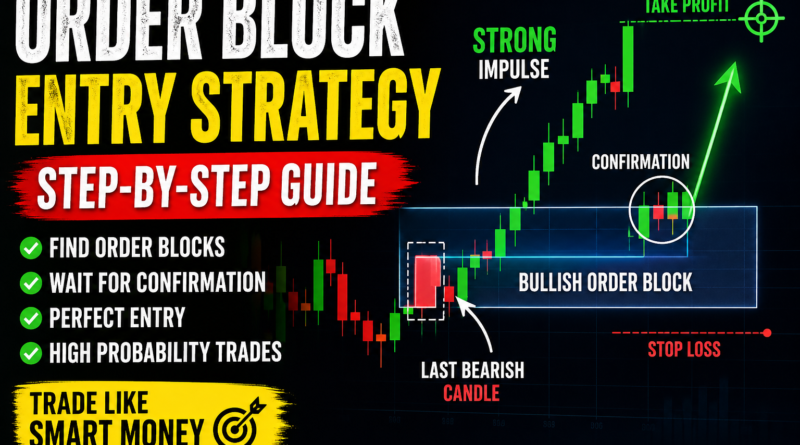
An order block is the last opposite candle before a strong and impulsive move.
- Bullish Order Block: The last bearish (down) candle before a strong upward move
- Bearish Order Block: The last bullish (up) candle before a strong downward move
In simple terms, it is the area where “smart money” likely placed large orders before pushing price strongly in one direction.
Price often returns to these areas later because they act like decision zones. Forex Trading for Beginners: Complete Guide to Pips, Leverage, Risk Management, and Trading Psychology
Why Order Blocks Work
The market does not move in a straight line. Large participants cannot enter all their positions at once.
Instead, they:
- Build positions gradually
- Create liquidity around key areas
- Leave behind “footprints” in price action
When price returns to an order block:
- Liquidity is revisited
- Unfilled orders may still exist
- The market often reacts again
This is why we wait for price to come back instead of chasing it. Why 90% of Traders Fail Prop Firm Challenges (Risk Management Explained)
Step-by-Step Order Block Entry Strategy
Step 1: Identify Market Structure First
Before drawing anything, always check structure.
- Higher highs and higher lows → bullish structure
- Lower highs and lower lows → bearish structure
Never use order blocks against the main direction unless you are experienced with counter-trend trading.
Step 2: Mark the Correct Order Block
Look for a strong impulsive move in one direction.
Then:
- Find the last opposite candle before the move
- Mark that candle as your order block zone
- Include body (and sometimes wick depending on volatility)
This zone is where price may react in the future.
Step 3: Wait for Price to Return
This is where most traders fail.
They see an order block and enter immediately. That is not trading, it is guessing.
Instead:
- Wait patiently
- Let price come back into the zone
- Do not force entries
In trading, patience is part of the strategy.
Step 4: Look for Confirmation Inside the Zone
Never enter just because price touches the order block.
Wait for real confirmation such as:
- Liquidity sweep (stop hunt above/below recent highs or lows)
- Change of Character (market structure shift)
- Strong rejection candles
- Sudden momentum move away from the zone
These signals show that the market is reacting, not just touching. How to Pass Funded Trading Challenges Step-by-Step
Step 5: Entry Execution
Once confirmation appears:
- Enter after structure shifts, not before
- Avoid entering in the middle of the zone without reason
- Focus on clean, timed entries
A good entry is about timing, not prediction.
Step 6: Stop Loss Placement
Keep your stop loss logical and based on structure:
- For buys → below the order block
- For sells → above the order block
If price fully breaks through the zone, your setup is invalid. Do not argue with the market.
Step 7: Take Profit Strategy
Do not guess random targets. Use market structure instead:
- Previous swing highs or lows
- Liquidity zones (areas where stops are likely placed)
- Imbalance zones (price inefficiency areas)
Think in a simple way: Where will price go to collect liquidity next? XAUUSD Strategy That Helps Traders Pass Prop Firm Challenges Consistently
Real Trading Insight (What Actually Matters)
Order blocks alone are not enough.
What improves consistency:
- Combine with liquidity analysis
- Use higher timeframe direction
- Trade during active sessions (London / New York)
- Focus on clean market structure
Also understand this clearly: not every order block will work. Losses are normal in trading.
The goal is not perfection. The goal is probability and consistency.
Common Mistakes Traders Make
Avoid these mistakes if you want better results:
- Marking too many order blocks everywhere
- Entering without confirmation
- Ignoring market structure
- Trading during low volatility periods
- Using very tight stop losses inside the zone
Most failed trades come from impatience, not strategy. Funded Forex Accounts: A Professional Guide to Prop Trading in 2026 (Institutional-Level Breakdown)
Final Thoughts
Order blocks give traders a structured way to understand where price may react. But they only work when used with discipline and context.
Do not treat them as guaranteed reversal zones. Treat them as areas of interest where you wait for confirmation.
The real edge in trading is not finding more setups, it is waiting for the right ones. Stay patient, let price come to your levels, and always wait for confirmation before risking capital.
Disclaimer
Disclaimer: Trading forex and CFDs involves significant risk and may not be suitable for all investors. This article is for educational purposes only and should not be considered financial advice.
Written by Shah – Forex trader and market analyst at Forex News 360.
This is best for new traders :
