Liquidity Grab vs Liquidity Sweep: What’s the Real Difference? (SMC Trading Guide)
Liquidity Grab vs Liquidity Sweep : If you’ve been trading Smart Money Concepts (SMC) for a while, you’ve likely seen price do the same frustrating thing again and again:
It pushes above a clear high… triggers breakout traders… and then either snaps back instantly or keeps going like nothing happened.
Most traders call both situations a “stop hunt.”
That’s where things go wrong.
Because in real market behavior, a liquidity grab and a liquidity sweep are not the same thing. They look similar on the surface, but the intention and structure behind them are very different.
Understanding this difference is what helps you stop guessing and start reading intent in price.
First, What is Liquidity in Trading?
Before comparing the two, you need to understand what liquidity actually means in practice.
Liquidity is simply:
Orders waiting in the market.
These include:
- Stop losses (below lows / above highs)
- Breakout entries (buy stops / sell stops)
- Pending limit orders
- Retail clustered positions
And where do they usually sit?
- Equal highs and equal lows
- Previous day high/low
- Swing highs and swing lows
- Obvious support and resistance zones
These areas become targets because institutions need liquidity to execute large positions.
So price is often engineered to move toward them. Internal vs External Liquidity Explained (With Real Trading Examples)
What is a Liquidity Grab?
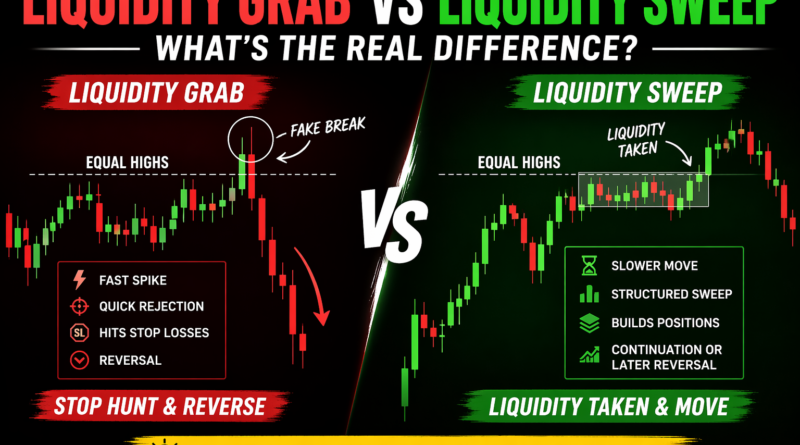
A liquidity grab is a fast, aggressive move beyond a key level that quickly reverses.
Think of it as a “snap move” designed to take stops and immediately shift direction.
Key Characteristics of a Liquidity Grab
- Very fast spike above/below a level
- Strong wick (rejection candle)
- Minimal follow-through
- Immediate reversal or strong opposite move
- Often happens at session highs/lows
What’s Actually Happening?
A liquidity grab is typically:
- Stop losses being triggered
- Liquidity being taken quickly
- Immediate order execution in the opposite direction
It is often associated with reversal intent, especially on lower timeframes.
Simple Example
Price is in a range and forms equal highs.
Then:
- Price spikes above highs quickly
- Breaks structure briefly
- Then instantly drops hard
What happened?
- Buy stops were triggered
- Sellers entered at premium liquidity
- Price reversed sharply
This is a classic liquidity grab.
Trader Interpretation
A liquidity grab often signals: “The market is taking stops before reversing.”
But confirmation is still required, it’s not automatic. Why Break of Structure (BOS) Fails and How to Filter It (SMC Price Action Guide)
What is a Liquidity Sweep?
A liquidity sweep is a more controlled and structured move that takes liquidity gradually.
It is not aggressive. It is methodical.
Key Characteristics of a Liquidity Sweep
- Slower movement through liquidity zones
- Multiple candles pushing through highs/lows
- Can continue in same direction or reverse later
- Often forms structure after taking liquidity
- Less emotional, more engineered flow
What’s Actually Happening?
A liquidity sweep usually indicates:
- Liquidity is being cleared in stages
- Market is building positions
- Distribution or accumulation may still be ongoing
- Direction is not immediately confirmed
Unlike a grab, this is not always a reversal signal.
Simple Example
Price breaks above previous highs but:
- Keeps pushing upward after the break
- Forms new structure above highs
- No immediate rejection occurs
What happened?
- Buy-side liquidity was taken
- But continuation suggests strength or accumulation
- No immediate reversal intent
Trader Interpretation
A liquidity sweep often means: “Liquidity has been taken, but direction is still developing.” How to Trade Break and Retest Without Getting Faked Out (Simple Price Action Guide)
Liquidity Grab vs Liquidity Sweep (Clear Comparison)
| Feature | Liquidity Grab 🔥 | Liquidity Sweep 📊 |
|---|---|---|
| Speed | Fast, sharp spike | Slow, controlled movement |
| Candles | 1–2 strong rejection wicks | Multiple candles through level |
| Market Intent | Immediate stop hunt | Liquidity collection phase |
| Reversal | Often immediate | Delayed or not guaranteed |
| Structure | Quick shift (CHoCH/BOS) | Builds structure over time |
| Trading Style | Reversal setup | Continuation or confirmation trade |
How to Trade a Liquidity Grab
Liquidity grabs are typically used for reversal-based trading models.
Step-by-Step Approach
1. Wait for the spike
Do NOT enter during the move. That’s where most traders get trapped.
2. Look for rejection
You want to see:
- Strong wick rejection
- Momentum shift
- Failure to hold above/below level
3. Confirm with structure shift
Drop to lower timeframe and look for:
- CHoCH (Change of Character)
- BOS (Break of Structure)
4. Enter on confirmation
Entry comes AFTER confirmation, not during the spike.
5. Target opposing liquidity
Usually:
- Equal lows after highs are taken
- Previous swing levels
- Range boundaries
How to Trade a Liquidity Sweep
Liquidity sweeps require more patience because direction is not immediately clear.
Step-by-Step Approach
1. Don’t react immediately
A sweep is not a signal by itself.
2. Wait for structure development
Look for:
- Consolidation
- New highs/lows forming
- Market stabilization
3. Identify intention
Ask:
- Is price continuing or failing?
- Is structure breaking or expanding?
4. Enter on pullback or confirmation
Common entries:
- Order blocks
- Fair value gaps
- Retests of swept level
5. Align with higher timeframe bias
Sweeps often act as continuation setups in strong trends. Premium vs Discount Zones Explained: A Practical Guide to Market Value in Forex (SMC Concept)
Common Mistakes Traders Make
Most losses come from misreading these two concepts.
1. Treating every spike as a reversal
Not every wick is a liquidity grab.
2. Entering too early
Jumping in before confirmation is the fastest way to get trapped.
3. Ignoring higher timeframe structure
A lower timeframe grab inside a strong trend may just be a continuation setup.
4. Over-trading “stop hunts”
Not all liquidity is designed for reversal.
Final Thoughts
The real difference between a liquidity grab and a liquidity sweep comes down to one thing:
Intent + structure.
- A liquidity grab is fast, aggressive, and often signals immediate reversal conditions.
- A liquidity sweep is structured, gradual, and often part of a larger continuation or distribution phase.
Once you stop labeling every move as a “stop hunt” and start reading how price behaves after taking liquidity, your entire perspective changes.
You stop reacting to candles. You start reading market intent. And that is where consistency begins to build in SMC-based trading.
If you want to go deeper into liquidity-based trading concepts, price action structure, and institutional-style analysis, continue building your understanding step by step rather than relying on isolated patterns.
Disclaimer
Disclaimer: Trading forex and CFDs involves significant risk and may not be suitable for all investors. This article is for educational purposes only and should not be considered financial advice.
Written by Shah – Forex trader and market analyst at Forex News 360.
This is best for new traders :

Pingback: Liquidity Sweep FVG Strategy: Best SMC Entry Model Explained
Pingback: Forex Risk Management Guide (2026) | Protect Your Trading Capital
Pingback: What is XAUUSD (Gold Trading)? Beginner Guide to Trading Gold