Why Gold is Rising and Falling This Month (2026 Market Analysis)
Gold Price Drivers April 2026: The month of April 2026 has proven to be a dramatic, high-stakes “tug-of-war” for global gold markets. While the precious metal remains pinned near historic, eye-watering highs compared to previous years, recent weeks have seen sharp volatility. Investors have witnessed sudden intraday spikes followed by minor technical pullbacks, leaving many retail buyers wondering where the market is headed next.
If you are looking at your jewelry investments, sovereign gold bonds, or digital gold and wondering what is driving these sudden shifts, you are not alone. The financial landscape right now is being pulled in two different directions.
To help you make sense of the market, here is a comprehensive, simplified breakdown of the macro-economic “Push” and “Pull” factors dictating the price of gold this month.
Why Gold Experienced a Pullback (The Pull Factors)
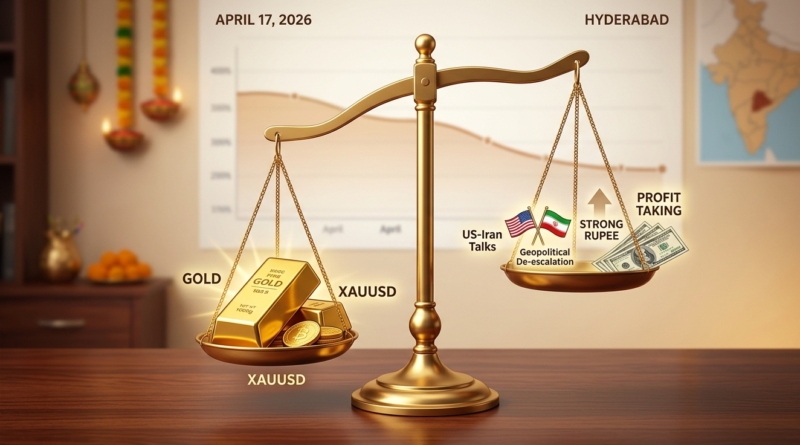
Around mid-April 2026, global spot gold (XAUUSD) eased slightly from its record-shattering peaks near $4,850 per ounce. Domestic prices in major Indian trading hubs like Delhi, Mumbai, and Chennai also saw a brief breather. This minor downward correction was driven by a combination of geopolitical shifting gears and technical trading behaviors.
1. The Geopolitical “Pause” Effect
For the past several quarters, the primary engine driving gold to record highs has been intense global instability. However, mid-April brought a glimmer of diplomatic hope. The announcement of a temporary, Pakistan-mediated ceasefire and opening of dialogue channels between the United States and Iran provided a brief window of relief for global markets.
In the financial world, gold acts as the ultimate “safe haven”—a financial bunker where investors hide their money when they fear war or economic collapse. When immediate military escalation pauses, fear premium evaporates. Confident investors temporarily rotate their capital out of non-yielding gold and back into riskier, higher-return assets like equities and corporate bonds.
2. A Resilient Indian Rupee (INR)
For domestic buyers in India, the price of gold isn’t just dictated by global demand; it is deeply tied to currency exchange rates. Because international spot gold is priced in US Dollars (USD), the Indian government and bullion banks must purchase it using dollars.
During the middle of the month, the Indian Rupee experienced a period of moderate strength against a stabilizing US Dollar. When the Rupee strengthens, it gains more purchasing power on the international stage. This currency appreciation effectively makes importing gold cheaper, allowing bullion dealers to pass a minor price reduction down to retail consumers in local jewelry markets.
3. Institutional Profit-Taking
Gold experienced an incredibly aggressive 10% surge in the opening months of 2026. In the world of institutional investing—where hedge funds and bullion banks trade billions—a rapid rise is always followed by a period of “profit-taking.”
As prices neared the upper boundaries of historical technical charts, automated trading algorithms and institutional money managers decided to lock in their yields. By selling off portions of their gold holdings to realize actual cash profits, they flooded the market with temporary supply. This institutional sell-off created the exact short-term downward pressure that triggered the mid-month dip.
Why the Big Trend Remains Bullish (The Push Factors)
Despite the minor price corrections seen on daily charts, seasoned market analysts emphasize that the underlying structural bull market for gold remains incredibly strong. The minor dips are widely considered “market corrections” rather than the end of the gold rush. Powerful long-term demand drivers continue to push prices upward from the bottom.
1. Festive and Wedding Season Demand (Akshaya Tritiya)
In India, gold is far more than a mere financial asset; it is a cultural and spiritual cornerstone. The arrival of Akshaya Tritiya on April 19, 2026, served as a massive catalyst for physical demand. Akshaya Tritiya is traditionally considered one of the most auspicious days of the year to purchase gold, believed to bring eternal prosperity.
Despite retail prices hovering at historic highs—tracking above ₹1.55 Lakh per 10 grams for 24-karat gold—consumer appetite remained remarkably resilient. Leading jewelry retail chains reported robust footfalls, particularly in South India, which historically accounts for nearly 40% of the country’s festive gold volumes. This massive wave of physical retail buying across thousands of showrooms nationwide acted as a hard floor, preventing local prices from crashing.
2. Aggressive Central Bank Accumulation
While retail consumers buy gold by the gram, global central banks buy it by the metric ton. Over the last few years, central banks across emerging economies have been on a historic gold-buying spree, and April 2026 was no exception.
Institutions like the People’s Bank of China (PBOC) and the National Bank of Poland have continued to aggressively accumulate gold reserves. These central banks are executing a long-term, multi-year sovereign strategy to diversify their reserves away from the US Dollar. Because central banks buy with a ten-to-twenty-year horizon, they completely ignore short-term daily price corrections. Their relentless institutional buying absorbs excess market supply and guarantees long-term upward pressure.
| Central Bank Buyer | Strategy Type | Impact on Global Markets |
| Emerging Economies (e.g., China) | De-dollarization & Diversification | Creates a permanent baseline demand, absorbing excess market supply. |
| European Institutions (e.g., Poland) | Economic Risk Mitigation | Hardens sovereign balance sheets against regional banking instabilities. |
3. Lingering Global Inflation and Fiat Volatility
Even as diplomatic talks offer temporary relief, the structural economic damage of sticky global inflation remains unresolved. The cost of living, energy, and raw materials continues to erode the purchasing power of traditional paper currencies.
When inflation remains stubborn, keeping wealth in a standard savings account effectively means losing money over time. Gold, which cannot be printed out of thin air by a government, maintains its intrinsic value over centuries. As long as retail investors and major institutions fear the eroding effects of inflation, money will continuously flow into gold as a protective financial shield.
The Verdict for April 2026
As April comes to a close, the gold market is navigating a classic consolidation phase, firmly holding its ground above the $4,700 per ounce mark globally. It is a market that has paused to catch its breath, digesting both local festive demand and complex global diplomacy.
Moving forward, the trajectory of gold hinges entirely on macroeconomic data. If the ongoing geopolitical negotiations stabilize further and global inflation numbers show signs of cooling, gold may continue to trade sideways or experience minor technical pullbacks toward $4,650. However, if diplomatic talks hit a roadblock or central bank accumulation intensifies ahead of the summer months, analysts widely expect gold to break past its current resistance and test the psychological $5,000 per ounce barrier.
For the everyday investor, the lesson of April 2026 is clear: short-term volatility is entirely normal. For those looking at long-term wealth preservation, these minor mid-month dips are being viewed not as a reason to panic, but as a strategic window of opportunity to accumulate a time-tested asset.
Disclaimer: Trading forex and CFDs involves significant risk and may not be suitable for all investors. This article is for educational purposes only and should not be considered financial advice.
Written by Shah – Forex trader and market analyst at Forex News 360.
