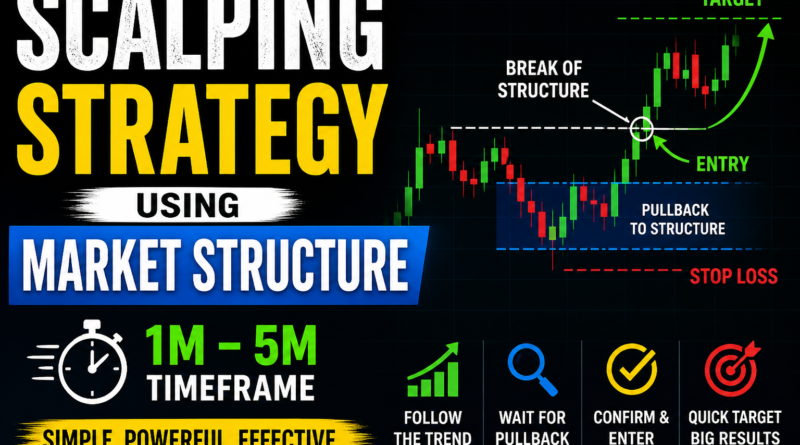
Scalping Strategy Using Market Structure (1M–5M Price Action Guide)
Market structure scalping strategy is one of the most effective approaches for short-term forex trading when applied correctly on 1M–5M charts.
Scalping in forex becomes consistent only when traders understand market structure, liquidity behavior, and confirmation-based execution.
Most traders fail because they focus on indicators instead of reading price movement properly.
The difference between consistent scalpers and losing traders is not the number of trades taken, but the ability to read where price is likely to react next and why.
This guide explains a structured, rules-based scalping model built around market structure and confirmation-based execution, commonly used in institutional-style intraday trading workflows.
1. Understanding Market Structure in Scalping Context
Market structure is the foundational framework that describes how price organizes itself over time.
Core Structure Types
- Bullish Structure: Higher highs (HH) and higher lows (HL)
- Bearish Structure: Lower highs (LH) and lower lows (LL)
- Range Structure: No directional expansion; liquidity accumulation phase
y = f(x)
While the equation above represents a function in abstract form, price action can be interpreted similarly: price is a dynamic function reacting to liquidity and order flow rather than randomness. Inducement in Trading: How Smart Money Traps Retail Traders (Simple Price Action Guide)
Why Structure Matters in Scalping
On lower timeframes:
- Noise increases significantly
- False breakouts are common
- Liquidity grabs happen frequently
Without structure, traders interpret randomness as opportunity. With structure, traders interpret intentional price behavior.
Institutional participation is often visible through:
- Stop-loss liquidity sweeps
- False breakouts before expansion
- Controlled displacement after accumulation
2. How to Read Market Structure on 1M–5M Charts
Lower timeframes require a simplified but strict reading model.
Step-by-Step Framework
Step 1: Identify Market Condition
Classify price into one of three states:
- Trending (expanding structure)
- Ranging (balanced liquidity)
- Transitioning (break of range → expansion)
Step 2: Mark Key Swing Points
Focus only on:
- Recent highs and lows
- Last structural break
- Impulse candle origin zones
Avoid cluttering charts with excessive indicators or levels. High Value SMC & Price Action Concepts (Next-Level Trading Guide)
Step 3: Observe Reaction, Not Just Levels
The key skill is not identifying levels—but observing:
- Does price respect or violate structure?
- Is rejection strong or weak?
- Is momentum increasing or fading?
3. Scalping Strategy Framework (Structured Execution Model)
This strategy follows a 3-phase execution model used in price action trading systems.
Phase 1: Trend Identification (Directional Bias)
Before entering any trade, define directional bias:
- If structure forms HH & HL → bullish bias
- If structure forms LH & LL → bearish bias
⚠️ Important:
Never assume reversal without structural confirmation.
Most scalping losses occur from trading counter-trend without confirmation.
Phase 2: Liquidity Pullback (Setup Formation)
After trend identification, price typically retraces.
This pullback often targets:
- Previous swing liquidity
- Minor support/resistance zones
- Inefficient price movement areas
This phase is where most retail traders enter too early.
Professional approach: Wait for price to return into a liquidity-rich area before considering execution.
Phase 3: Break of Structure Confirmation (Entry Trigger)
This is the decisive trigger mechanism.
For Buy Setup:
- Pullback occurs
- Price forms a higher low
- Breaks minor resistance (internal structure)
For Sell Setup:
- Pullback occurs
- Price forms a lower high
- Breaks minor support
Just like a geometric system depends on fixed relationships, structured trading depends on confirmation of balance shift before execution. Forex Risk Management: A Simple Guide to Protecting Your Money
4. Entry Model, Risk Control, and Targeting
Entry Execution
Enter only after:
- Structural break confirmation
- Momentum candle displacement
Avoid anticipating moves before confirmation.
Stop Loss Placement (Critical Rule)
Place stop loss based on structure, not emotion:
- Buy trades → below recent swing low
- Sell trades → above recent swing high
Never use arbitrary pip-based stops.
Take Profit Logic
Targets should align with:
- Next liquidity pool
- Previous structural resistance/support
- Intraday imbalance zones
Scalping is not about maximizing profit per trade, it is about consistent partial extraction of market movement.
5. Institutional Logic Behind the Strategy
This strategy works because it aligns with how liquidity is engineered in markets:
Key Concepts
- Markets move to capture liquidity first
- False moves often precede real expansion
- Break of structure confirms shift in order flow dominance
In simple terms: Price does not move randomly, it moves to fill orders and trigger stops before continuation.
6. Trading Psychology (Most Important Component)
Even a strong strategy fails without execution discipline.
Core Rules:
- Do not trade without confirmation
- Do not chase candles
- Do not overtrade 1M charts
- Accept that missing trades is normal
- Focus on consistency, not frequency
Professional scalpers often have low trade frequency but high precision. Moving Averages (EMA vs SMA): Complete Beginner Guide for Forex, Gold & Crypto Traders
7. Common Mistakes That Destroy Scalping Accounts
1. Early Entry
Entering before confirmation leads to exposure to liquidity traps.
2. Ignoring Higher Context
Even on 1M–5M charts, higher timeframe bias matters.
3. Emotional Stop Moving
Adjusting stop loss after entry removes structural logic.
4. Overtrading
More trades ≠ more profit. It often equals more loss.
8. Simple Execution Checklist
Before every trade, verify:
✔ Market structure is clear
✔ Directional bias is defined
✔ Pullback has occurred
✔ Liquidity zone is identified
✔ Break of structure confirmed
✔ Stop loss is structural
✔ Target is predefined
If any condition is missing → no trade RSI Indicator Explained | Overbought & Oversold Strategy for Trading
Final Thoughts
Scalping using market structure is not a fast reaction system, it is a structured decision-making model built on patience, confirmation, and liquidity understanding.
Traders fail on lower timeframes not because of complexity, but because of impulse-driven execution without structural validation.
When executed correctly, the 1M–5M charts become less chaotic and more predictable through repetition of liquidity behavior.
Disclaimer
Disclaimer: Trading forex and CFDs involves significant risk and may not be suitable for all investors. This article is for educational purposes only and should not be considered financial advice.
Written by Shah – Forex trader and market analyst at Forex News 360.
This is best for new traders :

Pingback: Break and Retest Strategy: How to Trade Without Getting Faked Out
Pingback: Best Time to Trade Gold in India (XAUUSD Trading Hours & Strategy 2026)
Pingback: Why BOS Fails: How to Filter Fake Break of Structure in Trading