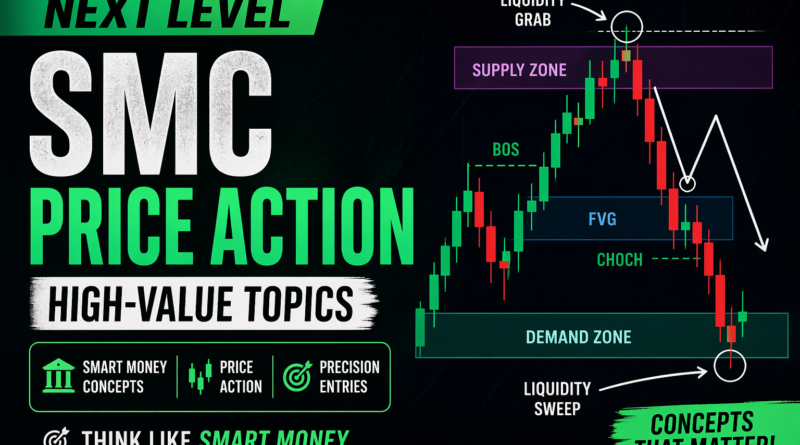
High Value SMC & Price Action Concepts (Next-Level Trading Guide)
SMC Trading Concepts: Most traders learn Smart Money Concepts (SMC) in a very surface-level way. They memorize terms like BOS, CHoCH, liquidity, FVG, and supply/demand. But even after learning all of this, they still struggle to trade consistently.
The problem is not the concepts themselves. The problem is how they are used in isolation instead of as a complete market narrative.
At a higher level, trading is not about spotting patterns. It is about understanding why price is moving and what it is trying to do next.
This guide focuses on deeper SMC thinking that helps you read the market more clearly and avoid low-quality trades.
1. Liquidity Is More Than Just Highs and Lows
Most traders are taught that liquidity is simply equal highs and equal lows. While that is correct, it is only the beginning.
Real liquidity exists in many other places:
- Trendline liquidity (retail traders love drawing trendlines)
- Session highs and lows (especially Asia range levels)
- Weak highs and weak lows (no strong displacement behind them)
- Internal range liquidity (small structure inside consolidation)
- Stop-loss clusters around obvious patterns
The key question is not “where are the highs and lows?”
It is: “Where are traders likely trapped?”
That is where liquidity truly builds.
Once you start thinking this way, you stop drawing random levels and start reading behavior. London Session Strategy: How to Catch the Real Move Without Getting Trapped
2. Inducement Happens Before the Real Move
One of the most misunderstood ideas in trading is inducement.
Before a real move happens, the market often creates a fake setup first.
You will see things like:
- A clean breakout that fails immediately
- A perfect-looking support or resistance bounce that reverses
- A small structure break that tricks early entries
These are not random movements. They are designed to attract liquidity.
The goal is simple: Get traders to enter early so their stop losses can be used as fuel.
Instead of reacting to the first move, experienced traders wait for the trap to complete first.
3. Displacement Is More Important Than Structure
Many traders focus heavily on structure breaks. But structure alone does not confirm strength.
What really matters is how price breaks structure.
A strong and valid move usually shows:
- Large impulsive candles
- Clean directional movement
- Clear imbalance left behind (Fair Value Gap)
- Minimal hesitation or overlapping candles
If the break is slow, messy, or weak, it is often not a real shift in control.
In simple terms: Weak displacement = weak conviction
And weak conviction often leads to reversals. How to Trade Break and Retest Without Getting Faked Out (Simple Price Action Guide)
4. Fair Value Gaps (FVG) Need Context
Fair Value Gaps appear everywhere on the chart. Because of that, many traders misuse them.
A gap alone is not a trading signal.
High-probability FVGs usually:
- Form after strong displacement
- Align with higher timeframe direction
- Appear near liquidity zones
- Support continuation, not random entries
Think of FVGs as inefficiency zones created by aggressive movement, not automatic buy or sell areas.
Without context, they are just empty spaces on a chart.
5. Premium and Discount Is About Market Structure, Not Just Fibonacci
Many traders apply Fibonacci levels mechanically and assume they are trading premium or discount zones correctly.
This is incomplete thinking.
Real premium and discount areas depend on:
- The current swing range (high to low or low to high)
- Market phase (accumulation, manipulation, distribution)
- Liquidity positioning above and below price
A “discount buy” is only valid if:
- The market structure supports bullish movement
- Liquidity has been taken appropriately
- The higher timeframe is aligned
Otherwise, buying in discount can still mean buying into a strong downtrend. How to Confirm a Valid CHoCH Before Entering a Trade (SMC Price Action Guide)
6. Time and Session Matter More Than Most Traders Realize
Price does not move the same way throughout the day.
Different sessions behave differently:
- Asia Session: Usually slow, ranging, or accumulation
- London Session: High volatility, manipulation, liquidity grabs
- New York Session: Continuation or major reversals
Trading without considering time is like driving without knowing traffic conditions.
Even a good setup can fail if it appears in the wrong session.
Timing often filters out low-quality trades.
7. Confluence Is About Alignment, Not Complexity
Many traders believe confluence means stacking indicators or adding more confirmations.
That is incorrect.
True confluence in SMC is simple:
- Liquidity sweep + displacement
- FVG aligning with structure
- Market structure shift matching session timing
Confluence is not about adding more tools.
It is about multiple clean ideas pointing in the same direction naturally.
If you need too many confirmations, the setup is usually already weak.
8. Narrative Is More Important Than Individual Setups
This is one of the biggest mindset shifts in trading.
Instead of asking: “Is this a buy or sell setup?”
You should ask: “What is the market trying to do right now?”
For example:
- Is price collecting liquidity above equal highs?
- Is it rebounding after filling inefficiencies?
- Is it building pressure for a breakout or reversal?
When you understand the story behind price, entries become obvious and less emotional.
You are no longer reacting, you are anticipating behavior. Liquidity Grab vs Liquidity Sweep: What’s the Real Difference? (SMC Trading Guide)
Final Thoughts
Most traders do not fail because they lack knowledge.
They fail because they:
- Use concepts in isolation
- Enter too early without context
- Ignore liquidity and timing
- Focus on setups instead of market behavior
At a higher level, SMC trading is not about memorizing patterns.
It is about understanding:
- Where liquidity is
- How price manipulates traders
- When displacement shows real intent
- How different concepts connect together
You do not need more indicators or more strategies.
You need better understanding of what price is doing right now.
Once you start reading the market as a story instead of a series of signals, everything becomes clearer—and your trading naturally becomes more disciplined and selective.
Disclaimer
Disclaimer: Trading forex and CFDs involves significant risk and may not be suitable for all investors. This article is for educational purposes only and should not be considered financial advice.
Written by Shah – Forex trader and market analyst at Forex News 360.
This is best for new traders :

Pingback: London Session Strategy: How to Catch the Real Move Without Getting Trapped
Pingback: Premium and Discount Zones Forex Explained: Complete Smart Money (SMC) Guide
Pingback: Market Structure Scalping Strategy (1M–5M Price Action Guide)
Pingback: How to Draw Fibonacci Retracement Levels: Step-by-Step Trading Guide for Beginners
Pingback: What is XAUUSD (Gold Trading)? Beginner Guide to Trading Gold