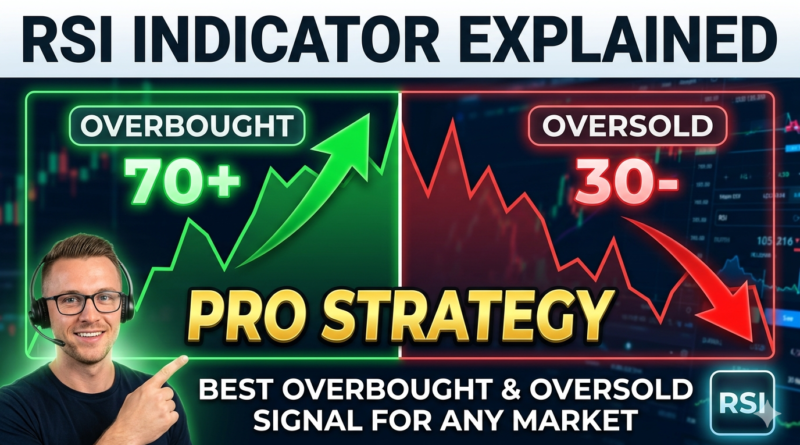
RSI Indicator Explained | Overbought & Oversold Strategy for Trading
The RSI Indicator Explained (Relative Strength Index) is one of the most widely used momentum tools in technical analysis. It helps traders understand whether price is gaining strength, losing momentum, or approaching exhaustion.
You’ll find RSI used across all major markets:
- Forex (EURUSD, GBPUSD, USDJPY)
- Gold (XAUUSD)
- Crypto (Bitcoin, Ethereum)
- Stocks and indices
This guide breaks down RSI in a simple, practical way so you can actually apply it to trading decisions instead of just memorizing levels.
What is RSI (Relative Strength Index)?
RSI is a momentum oscillator that measures: The speed and strength of price movements.
It helps answer a simple question:
- Is the market moving too fast in one direction?
RSI Range:
RSI moves between 0 and 100.
- 0 → extreme selling pressure
- 100 → extreme buying pressure
Core Idea:
RSI does NOT predict the future.
It measures momentum exhaustion and strength.
RSI Formula (Simple Understanding)
RSI = 100 – \frac{100}{1 + RS}
Where:
- RS = Average Gain ÷ Average Loss (usually 14 periods)
You don’t calculate this manually, trading platforms do it automatically.
RSI Levels Explained
Traders use key levels to interpret market conditions:
Overbought Zone (Above 70)
When RSI is above 70:
- Price has risen quickly
- Buying pressure is strong
- Market may be stretched
Meaning:
- Possible pullback
- Possible reversal
- Or continuation in strong trends
⚠️ Important: In strong bullish trends, RSI can remain overbought for long periods.
Oversold Zone (Below 30)
When RSI is below 30:
- Price has dropped sharply
- Selling pressure is strong
- Market may be temporarily undervalued
Meaning:
- Possible bounce
- Possible reversal
- Or continuation in strong downtrend
Neutral Zone (Around 50)
- Above 50 → bullish bias
- Below 50 → bearish bias
This is often used for trend confirmation. What is Forex Trading? A Complete Beginner Guide (2026)
What is Overbought in RSI?
Overbought does NOT mean “sell immediately.”
It simply means: Price has moved too far, too fast to the upside.
What traders misunderstand:
- RSI > 70 ≠ automatic sell signal
- RSI can stay overbought in strong trends
Better interpretation:
- Look for exhaustion
- Wait for structure shift
- Confirm before entry
What is Oversold in RSI?
Oversold also does NOT mean “buy immediately.”
It means: Price has fallen aggressively and may be stretched.
Key mistake traders make:
They buy every RSI below 30, this leads to losses in strong downtrends.
Better approach:
- Wait for reversal confirmation
- Look for bullish structure shift
- Combine with support zones
How Traders Use RSI in Real Trading
RSI becomes powerful only when used in context.
1. Reversal Trading
- RSI above 70 → look for sell setup
- RSI below 30 → look for buy setup
But only after confirmation (not blindly).
2. Trend Confirmation
- RSI above 50 → bullish trend
- RSI below 50 → bearish trend
This helps avoid trading against momentum. Break of Structure vs Change of Character (BOS vs CHoCH) – Smart Money Concepts Guide
3. RSI Divergence Strategy (Advanced)
Divergence is one of the strongest RSI signals.
Bearish Divergence
Price:
- Makes higher high
RSI:
- Makes lower high
Meaning: Momentum is weakening → possible reversal down
Bullish Divergence
Price:
- Makes lower low
RSI:
- Makes higher low
Meaning: Selling pressure is weakening → possible reversal up
Key Insight:
Divergence shows hidden weakness in trend momentum.
Best RSI Settings
Default setting is 14 periods, but traders adjust based on strategy.
Scalping
- RSI 7–10
- Fast signals
- More noise
Day Trading
- RSI 14 (standard)
- Balanced accuracy
Swing Trading
- RSI 14–21
- Smoother signals
- Fewer false signals
Liquidity Grab vs Liquidity Sweep: What’s the Real Difference? (SMC Trading Guide)
RSI Across Different Markets
Forex
- Works well in ranging conditions
- Best with structure confirmation
Gold (XAUUSD)
- Strong trending behavior
- RSI can stay extreme longer
- Needs trend alignment
Crypto
- Very volatile
- RSI signals appear frequently
- Requires strong risk control
Limitations of RSI
RSI is powerful, but not perfect.
1. False Signals in Trends
- RSI overbought/oversold can persist
- Trend continuation ignored by beginners
2. Sideways Markets
- RSI gives many fake signals
- Needs structure filtering
3. Not a Standalone System
RSI alone is not enough for consistent trading.
High Value SMC & Price Action Concepts (Next-Level Trading Guide)
Best RSI Strategy Combination
RSI becomes much more powerful when combined with:
1. Market Structure
- Trend direction confirmation
- BOS / CHoCH context
2. Support & Resistance
- RSI signals near key levels are stronger
3. Price Action
- Candlestick confirmation
- Rejection patterns
4. Trend Indicators (Optional)
- Moving Averages for direction bias
Final Conclusion
The RSI Indicator is not a magic buy/sell tool.
It is a momentum measurement system that helps traders understand:
- Strength of trend
- Exhaustion zones
- Possible reversal areas
- Momentum divergence
Key Takeaway: RSI works best when it confirms context, not when it is used alone.
If you combine RSI with structure, liquidity, and price action, it becomes a high-quality confirmation tool instead of a misleading standalone indicator.
If you want to go deeper, continue studying how RSI behaves in trending vs ranging markets, that’s where real consistency starts forming.
Disclaimer
Disclaimer: Trading forex and CFDs involves significant risk and may not be suitable for all investors. This article is for educational purposes only and should not be considered financial advice.
Written by Shah – Forex trader and market analyst at Forex News 360.
This is best for new traders :

Pingback: Market Structure Scalping Strategy (1M–5M Price Action Guide)
Pingback: Internal vs External Liquidity Explained (Real Trading Examples)