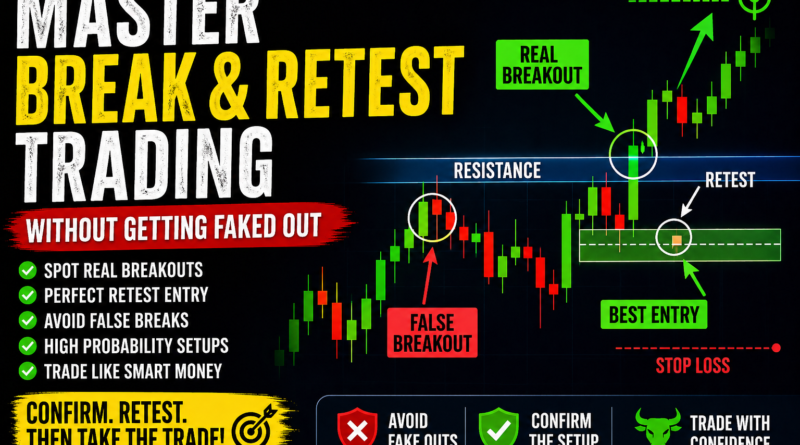
How to Trade Break and Retest Without Getting Faked Out (Simple Price Action Guide)
The Break and Retest strategy is one of the most reliable price action methods in trading. When used correctly, it can help you enter trades with clear structure and good timing.
But in reality, this is also one of the most misused concepts. Many traders see a breakout, rush into a trade, and then get stopped out when price suddenly reverses. It feels like manipulation—but most of the time, the real issue is simple: there was no confirmation.
This guide explains how Break and Retest actually works and how to trade it in a structured way to reduce fakeouts and improve consistency on lower and higher timeframes.
What Is a Break and Retest?
A Break and Retest happens in three simple steps:
- Price breaks a key support or resistance level
- Price comes back to test that same level
- Price continues in the breakout direction
In simple terms, the market breaks a level, returns to “test it,” and then moves away.
This happens because large participants in the market often need liquidity before continuing the move. The retest is where that liquidity is usually collected. Scalping Strategy Using Market Structure (1M–5M Price Action Guide)
Why Most Traders Get Faked Out
Most losing trades in Break and Retest come from the same mistakes:
- Entering immediately after the breakout candle
- Not waiting for confirmation
- Ignoring the overall market structure
- Treating support and resistance as exact lines instead of zones
A breakout alone is not a trade signal. It is only the first step of a possible setup.
The Correct Structure of a Break and Retest Setup
A high-quality setup always has three clear phases:
1. The Break
Price moves strongly through a key level.
A weak or slow breakout is often unreliable.
2. The Retest
Price returns to the broken level.
This is the phase where most traders get trapped.
3. The Reaction
Price rejects the level and continues in the breakout direction.
If the reaction is weak or unclear, the setup should be avoided.
The Most Important Skill: Waiting for Confirmation
Never enter a trade just because price touches a level.
Instead, wait for clear signs that the market is reacting in your favor.
Common confirmation signals include:
- Pin bars (long wick rejecting the level)
- Engulfing candles showing strong momentum
- Slow pullback with weak pressure against the trend
- Strong continuation after the retest
This patience is what separates emotional trading from consistent trading. Best Time to Trade XAUUSD (Gold) for Maximum Volatility
Use Market Structure Before Every Trade
Before taking any Break and Retest setup, always check the structure first.
Ask yourself:
- Is the market trending or ranging?
- Are higher highs and higher lows (or lower lows) forming?
- Does the breakout align with the current direction?
Breakouts against the main structure are more likely to fail or become fakeouts.
Always Consider Higher Timeframe Context
One of the biggest mistakes traders make is focusing only on lower timeframes.
For example:
- A breakout on the 15-minute chart
- Into a strong resistance zone on the 4-hour chart
In this situation, the breakout is often weak and more likely to fail.
Simple rule:
Only take Break and Retest trades that align with the higher timeframe trend.
- If the daily trend is bullish → focus on buy setups
- If the daily trend is bearish → focus on sell setups
Use Zones, Not Exact Lines
Support and resistance are not single prices. They are areas where price reacts.
If you treat them as exact lines, you will often get stopped out by normal market wicks.
Instead:
- Mark a small zone around the level
- Allow price to move slightly above or below it
- Wait for reaction inside the zone, not just the first touch
This approach alone can significantly reduce false entries. Institutional Trading Report: Why Your Strategy Works on Paper but Fails in Live Execution
Advanced Filter: Change of Character (ChoCH)
For higher-quality entries, you can use a simple confirmation called “Change of Character.”
When price retests a level:
- Drop to a lower timeframe (like 5-minute chart)
- Watch for a structure shift
- Example in a buy setup: price forms a higher high and higher low
This confirms that momentum has shifted back in your direction.
It is one of the most reliable ways to avoid fakeouts.
Break and Retest Checklist
Before entering any trade, make sure you can answer “yes” to most of these:
- ✔ A clean breakout has occurred
- ✔ Price is retesting a valid zone
- ✔ A rejection signal is visible
- ✔ Higher timeframe supports the direction
- ✔ No major nearby level is blocking the move
If too many conditions are missing, it is better to skip the trade. Institutional Market Report: What 7 Days of Watching Live Forex Analysis Channels Reveals About Real-Time Trading Behavior
Final Thoughts
Break and Retest trading is not about predicting where price will go. It is about waiting for confirmation that a breakout is real and sustainable.
Most traders fail because they chase early moves instead of waiting for structure and reaction to develop.
If you learn to slow down and wait for confirmation, you will naturally avoid many fakeouts and improve your trading consistency over time.
In trading, success is not about taking more trades. It is about taking better trades.
Disclaimer
Disclaimer: Trading forex and CFDs involves significant risk and may not be suitable for all investors. This article is for educational purposes only and should not be considered financial advice.
Written by Shah – Forex trader and market analyst at Forex News 360.
This is best for new traders :

Pingback: Why Most Beginner Traders Lose Money in Forex Trading (And How to Avoid It)
Pingback: 90% of Traders Fail Because of This One Prop Firm Rule (Risk Management Explained Simply)
Pingback: Best Time to Trade XAUUSD (Gold) for Maximum Volatility
Pingback: Best Time to Trade Gold in India (XAUUSD Trading Hours & Strategy 2026)
Pingback: SMC Trading Concepts: High Value Smart Money & Price Action Guide