Premium vs Discount Zones Explained: A Practical Guide to Market Value in Forex (SMC Concept)
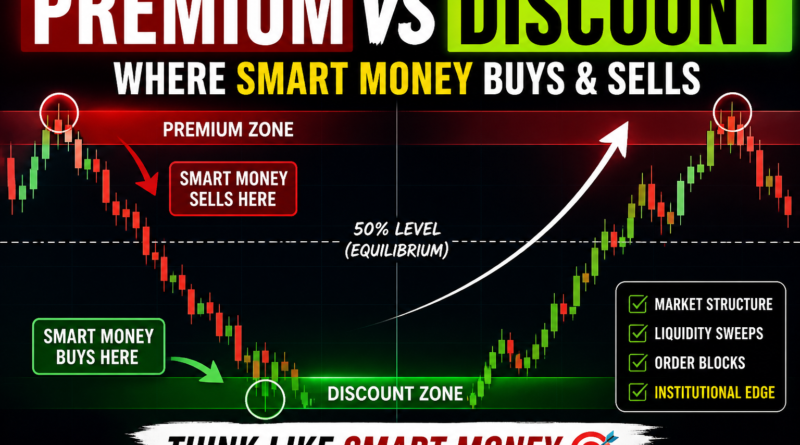
Premium and discount zones forex is a core concept in Smart Money Concepts (SMC) used to understand whether price is relatively expensive or cheap within a market structure. Traders use this framework to analyze market value instead of relying only on traditional support and resistance.
In simple terms, premium and discount zones help identify where price is positioned within a swing range and how market participants may react at different levels.
What Are Premium and Discount Zones?
Premium and discount zones are created from a full price swing between a swing high and a swing low.
- Premium Zone → Upper part of the range (relatively higher price)
- Discount Zone → Lower part of the range (relatively lower price)
Simple Meaning
- 📈 Premium Zone → Area where price is relatively expensive
- 📉 Discount Zone → Area where price is relatively cheaper
The midpoint of the range is called the equilibrium level (50%), which divides premium and discount areas.
How These Zones Are Formed
To identify premium and discount zones, traders follow a simple structure:
1. Identify Swing Points
- Mark a clear swing high
- Mark a clear swing low
2. Define the Range
The movement between these points becomes the full reference structure.
3. Apply the 50% Level
- Above 50% → Premium zone
- Below 50% → Discount zone
Some traders also use Fibonacci retracement tools, but the core idea is based on market structure, not indicators. High Value SMC & Price Action Concepts (Next-Level Trading Guide)
How Price Behavior Is Commonly Interpreted
In Smart Money Concepts, market movement is often divided into three phases:
1. Accumulation Phase (Discount Area)
- Price moves in a lower range
- Buying pressure slowly builds
- Market prepares for potential expansion
2. Expansion Phase
- Strong directional movement occurs
- Liquidity may be taken from key levels
- Market structure shifts become visible
3. Distribution Phase (Premium Area)
- Price moves into higher levels
- Profit-taking often increases
- Late entries may occur in strong trends
This model helps explain behavior, but it does not guarantee outcomes. Inducement in Trading: How Smart Money Traps Retail Traders (Simple Price Action Guide)
Important Clarification: Common Misunderstandings
1. Premium Zone Does NOT Mean “Sell”
Price entering a premium zone does not automatically mean a selling opportunity.
Markets can remain in premium conditions for long periods during strong trends.
Key context factors include:
- Market structure direction
- Liquidity behavior
- Momentum strength
2. Discount Zone Does NOT Mean “Buy”
Price in a discount zone does not guarantee a reversal.
Markets can continue falling even in discounted conditions.
Important confirmation factors:
- Structural shift in direction
- Liquidity sweep
- Reaction from demand zones
Example of Market Behavior (Conceptual)
Consider a bearish market scenario:
- Price moves lower into a discount zone
- Traders assume continuation of downtrend
- Liquidity below previous lows is taken
- Market stabilizes and structure shifts upward
- A reversal or retracement begins
This behavior is often described in SMC as a liquidity-driven cycle, but outcomes always depend on real-time market conditions. How to Trade Break and Retest Without Getting Faked Out (Simple Price Action Guide)
Practical Way to Use Premium & Discount Zones
Instead of using zones alone, traders often combine them with:
Potential Sell Conditions (Premium Context)
- Price is in higher range
- Liquidity above highs has been taken
- Structure shows weakness in bullish momentum
- Clear rejection or shift appears
Potential Buy Conditions (Discount Context)
- Price is in lower range
- Liquidity below lows has been taken
- Market structure begins shifting bullish
- Demand reaction becomes visible
Common Mistakes Traders Should Avoid
- Using premium/discount zones without context
- Ignoring higher timeframe structure
- Treating Fibonacci as a prediction tool
- Entering trades without confirmation
- Overtrading every zone level
Key Takeaways
- Premium = relatively high price area
- Discount = relatively low price area
- They describe market context, not trade signals
- Structure and liquidity must confirm decisions
- Zones alone are not enough for trading
Scalping Strategy Using Market Structure (1M–5M Price Action Guide)
Frequently Asked Questions (FAQ)
1. Are premium and discount zones a trading strategy?
No. They are a market structure concept, not a complete strategy. They must be combined with liquidity, structure, and confirmation.
2. Can I buy automatically in discount zones?
No. Price can stay in discount zones during strong downtrends. You should always wait for confirmation such as structure shift or liquidity reaction.
3. Can I sell automatically in premium zones?
No. Premium zones can exist during strong uptrends. Selling without confirmation can lead to losses.
4. What is the best timeframe to use this concept?
Higher timeframes such as 1H, 4H, and Daily provide more reliable structure and clearer zones.
5. Do professional traders use premium and discount zones?
They use the concept as part of a broader framework that includes:
- liquidity analysis
- market structure
- execution timing
It is never used in isolation.
6. What is the biggest mistake beginners make?
The biggest mistake is treating:
- discount = buy
- premium = sell
Without considering trend, structure, and liquidity. Market Bias in Forex: Institutional Smart Money Guide to Directional Trading (SMC Concept)
Final Note (Important)
This article is for educational purposes only and does not constitute financial advice. Forex trading involves risk, and you may lose part or all of your capital. No strategy or concept guarantees profit. Always use proper risk management and practice in a demo environment before trading live.
Optional Learning Path
If you want to study further, focus on:
Multi-timeframe analysis
Market structure shifts (MSS / MSB)
Liquidity zones and stop hunts
Order blocks and fair value gaps
Disclaimer
Disclaimer: Trading forex and CFDs involves significant risk and may not be suitable for all investors. This article is for educational purposes only and should not be considered financial advice.
Written by Shah – Forex trader and market analyst at Forex News 360.
This is best for new traders :

Pingback: Best Time to Trade Gold in India (XAUUSD Trading Hours & Strategy 2026)