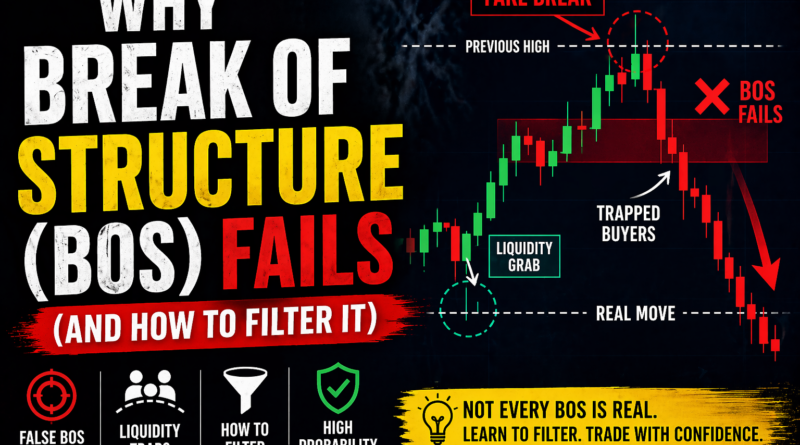
Why Break of Structure (BOS) Fails and How to Filter It (SMC Price Action Guide)
Why BOS Fails – If you have been trading Smart Money Concepts (SMC) or price action strategies for some time, you have probably seen this situation many times:
Price breaks structure → you enter the trade → market immediately reverses.
On paper, everything looked correct. The structure broke, the setup was clear, and the entry felt valid. But the trade still failed.
This is one of the most frustrating experiences in trading, and it leads many traders to doubt their strategy.
The truth is simple: not every Break of Structure (BOS) is real. Many are weak signals, and some are direct traps designed to mislead retail traders.
To trade BOS properly, you need to understand why it fails and how to filter low-quality breaks.
What a BOS Is Supposed to Mean
In theory, a Break of Structure (BOS) signals a continuation of trend direction.
- In an uptrend → breaking a previous high confirms bullish continuation
- In a downtrend → breaking a previous low confirms bearish continuation
In simple terms, BOS should mean: the market is continuing in the same direction with strength.
However, the market does not always behave in a clean or textbook way. A break alone does not guarantee direction or control.
This is where most traders make mistakes. Scalping Strategy Using Market Structure (1M–5M Price Action Guide)
Why Break of Structure Fails
There are several key reasons why BOS fails in real market conditions. Understanding these is essential for filtering bad trades.
1. Weak or No Displacement
This is the most common reason.
A valid BOS should show strong momentum. But many failed BOS setups look like this:
- Slow movement through the level
- Weak candles with long wicks
- No clear direction or urgency
- Choppy price action
This is not real intent. It is just price drifting.
A strong BOS usually has:
- Large impulsive candles
- Clean body closes beyond structure
- Imbalance left behind (inefficiency)
No displacement = no real conviction.
2. BOS Into Higher Timeframe Resistance or Support
One of the biggest mistakes traders make is ignoring higher timeframe context.
For example:
- A clean BOS on the 5-minute chart
- But price is hitting a strong 1-hour resistance zone
What happens next?
- Lower timeframe shows breakout
- Higher timeframe rejects the move
- Price reverses sharply
This is why BOS cannot be traded in isolation. Context always matters more than the signal.
3. Liquidity Has Not Been Taken
Before any strong directional move, the market usually targets liquidity.
Liquidity exists above highs and below lows where stop losses are placed.
If a BOS happens without:
- Sweeping equal highs/lows
- Taking previous swing liquidity
- Grabbing stop losses first
Then the move is often incomplete.
In many cases, this becomes inducement, not a real shift.
Retail traders enter early, while smart money is still collecting liquidity. London Session Strategy: How to Catch the Real Move Without Getting Trapped
4. BOS as an Inducement Trap
Sometimes, the Break of Structure itself is the trap.
Here is how it works:
- Price breaks structure slightly
- Retail traders enter expecting continuation
- Liquidity builds from breakout entries
- Market reverses and takes stops
- Then the real move begins
This is why blindly trusting every BOS leads to consistent losses.
A break without context is not confirmation, it is exposure.
5. Choppy or Range Market Conditions
BOS works best in trending markets.
Inside a range, structure becomes unreliable.
You will often see:
- BOS up → fails
- BOS down → fails
- Price rotating back and forth
This is not a trend. It is noise.
In consolidation, breaks of structure have very low reliability. Why Most Beginner Traders Lose Money in Forex Trading
How to Filter a High-Quality BOS
Now that you understand why BOS fails, let’s focus on how to identify the valid ones.
1. Wait for Strong Displacement
Do not react to the break itself. React to how it breaks.
Ask:
- Did price move with strength?
- Was the break fast and clean?
- Did it leave an imbalance behind?
If the answer is no, skip the setup.
Weak breaks are usually traps.
2. Always Check Higher Timeframe Context
Before trusting any BOS, zoom out.
Check:
- Overall trend direction
- Key supply and demand zones
- Whether price is at premium or discount levels
A strong BOS in the wrong location is still a low-quality trade. Why 90% of Traders Fail Prop Firm Challenges (Risk Management Explained)
3. Look for Liquidity First
High-probability BOS setups often follow this sequence:
- Liquidity sweep
- Displacement move
- Break of structure
- Continuation or retracement entry
If liquidity has not been taken, patience is required.
4. Avoid Trading in Ranges
If the market is stuck in a sideways structure:
- Do not rely on BOS signals
- Focus on range highs and lows instead
- Wait for breakout + confirmation outside the range
BOS becomes meaningful only in trending environments.
5. Combine BOS With Other Concepts
A strong BOS is rarely isolated. It often aligns with:
- Fair Value Gaps (FVG)
- Order blocks
- Key support/resistance zones
- Liquidity areas
This combination creates confluence, which significantly improves accuracy.
Example of a Failed BOS Setup
A common trap looks like this:
- Price breaks a recent high
- Traders assume bullish continuation
- No prior liquidity sweep
- Weak momentum behind the move
- Price is near higher timeframe resistance
Result:
- Buyers enter late
- Price reverses sharply
- Stops are taken
- Market continues in original direction
This is not bad luck. It is lack of confirmation. XAUUSD Strategy That Helps Traders Pass Prop Firm Challenges Consistently
The Mindset Shift You Need
Instead of asking: “Did structure break?”
Start asking: “Was this break meaningful?”
That single question changes how you view the market.
It forces you to evaluate:
- Strength
- Context
- Liquidity
- Location
Not just a candle closing above or below a level.
Final Thoughts
Break of Structure is not a bad concept. It is simply misunderstood.
On its own, BOS is weak and unreliable. But when combined with:
- Liquidity analysis
- Market structure context
- Strong displacement
- Higher timeframe alignment
It becomes a powerful confirmation tool.
You do not need to trade every break. In fact, you should avoid most of them.
The goal is not to catch every move, it is to avoid low-quality ones.
In trading, survival is built on selectivity, not activity.
Because in most cases, the obvious break is not the real opportunity—it is the trap before it.
Disclaimer
Disclaimer: Trading forex and CFDs involves significant risk and may not be suitable for all investors. This article is for educational purposes only and should not be considered financial advice.
Written by Shah – Forex trader and market analyst at Forex News 360.
This is best for new traders :

Pingback: Kill Zones in Forex: Smart Money Timing Strategy for Better Entries
Pingback: How to Draw Fibonacci Retracement Levels: Step-by-Step Trading Guide for Beginners
Pingback: Liquidity Grab vs Liquidity Sweep: Key Differences Every Trader Must Know