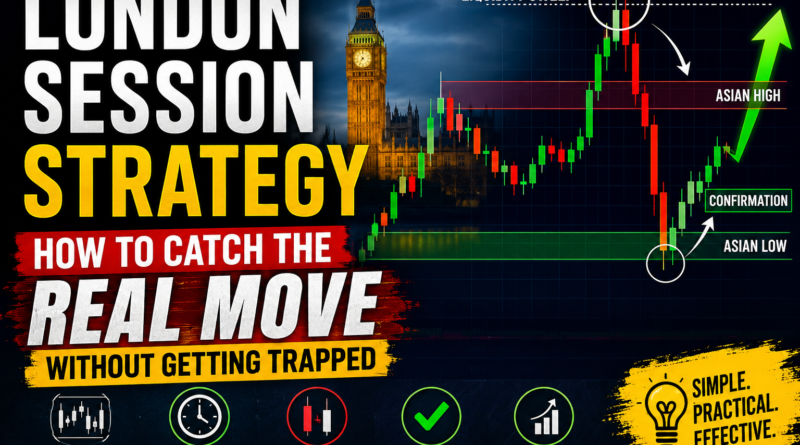
London Session Strategy: How to Catch the Real Move Without Getting Trapped
The London session is one of the most important trading periods in Forex.
It is often where strong moves start, especially in major pairs and Gold (XAUUSD).
But many traders still struggle during this session.
The main reason is simple:
They enter too early and get caught in false moves.
In most cases, price moves in a way that looks like a breakout first… but later reverses before the real direction starts.
If you are not patient, you often end up trading the trap instead of the actual move.
What You Will Learn
- What usually happens during the London session
- When real market moves often start
- How to time entries more effectively
- Common mistakes traders make
- A simple step-by-step approach
Simple Explanation of London Session
The London session is when a large amount of trading volume enters the market.
During this time:
- Liquidity increases
- Volatility becomes higher
- Price movements become more active
However, the first move of the session is often not the real direction.
In many cases, price first moves to take liquidity before deciding the actual trend.
This means early entries can easily get trapped. London Session Strategy: How to Catch the Real Move Without Getting Trapped
How London Session Trading Works (Step-by-Step)
1. Mark the Asian Session Range
Before London opens, I always mark the Asian session range:
- Asian high
- Asian low
These levels are important because price often reacts around them during London hours.
2. Wait for London Open
I avoid entering trades before London opens.
The reason is simple:
Early movement is often unstable and can be misleading.
Waiting helps avoid unnecessary losses.
3. Watch for Liquidity Sweeps
After London opens, price often moves quickly toward liquidity.
Common behavior includes:
- Breaking above Asian high and then dropping
- Breaking below Asian low and then rising
This is often part of normal market structure.
4. Wait for Confirmation
I do not enter based on the initial move alone.
I wait for confirmation such as:
- Clear rejection from a level
- Break of structure (market direction shift)
- Strong momentum in one direction
This step helps filter weak setups.
5. Enter on Pullback
Instead of entering at the extreme point of a move, I wait for a pullback.
Common areas include:
- Order blocks
- Fair Value Gaps (FVG)
- Retest zones
This usually provides better entry conditions and risk control.
Important Trading Logic Most Traders Miss
A common mistake is trying to catch the first move of the session.
But in reality:
- The first move is often a liquidity grab
- The real direction comes after confirmation
- Fast moves are not always safe entries
Sometimes the best trade is not the first opportunity, but the second confirmed move. High Value SMC & Price Action Concepts (Next-Level Trading Guide)
Example of Market Behavior
Let’s say:
Price breaks above the Asian high.
At first, it looks like a bullish breakout.
But then:
- Price slows down
- No strong continuation follows
- Market starts reversing
This is often a liquidity sweep.
After that, if price breaks structure to the downside, that is usually a clearer opportunity.
Many traders lose money by entering during the first breakout. Internal vs External Liquidity Explained (With Real Trading Examples)
Common Mistakes in London Session Trading
- Entering before London open
- Chasing the first breakout
- Ignoring liquidity concepts
- Not waiting for confirmation
- Overtrading multiple setups
Simple Rules to Follow
- Mark Asian session range first
- Wait for liquidity sweep
- Confirm direction before entry
- Enter only after confirmation
- Always manage risk properly
Final Thoughts
The London session can offer strong trading opportunities, but only when approached with patience and structure.
Most trading mistakes happen because traders try to predict the move instead of waiting for confirmation.
A better approach is simple:
Wait for the market to show its direction, then follow it.
Disclaimer
Disclaimer: Trading forex and CFDs involves significant risk and may not be suitable for all investors. This article is for educational purposes only and should not be considered financial advice.
Written by Shah – Forex trader and market analyst at Forex News 360.
This is best for new traders :
How to Trade Bitcoin for Beginners: A Simple 2026 Guide
What is Forex Trading? A Complete Beginner Guide (2026)

Pingback: Why Your Strategy Works But You Still Lose in Trading
Pingback: Kill Zones in Forex: Smart Money Timing Strategy for Better Entries
Pingback: Best Time to Trade XAUUSD (Gold) for Maximum Volatility
Pingback: Break of Structure vs Change of Character (BOS vs CHoCH) Smart Money Concepts Guide
Pingback: SMC Trading Concepts: High Value Smart Money & Price Action Guide
Pingback: Why BOS Fails: How to Filter Fake Break of Structure in Trading