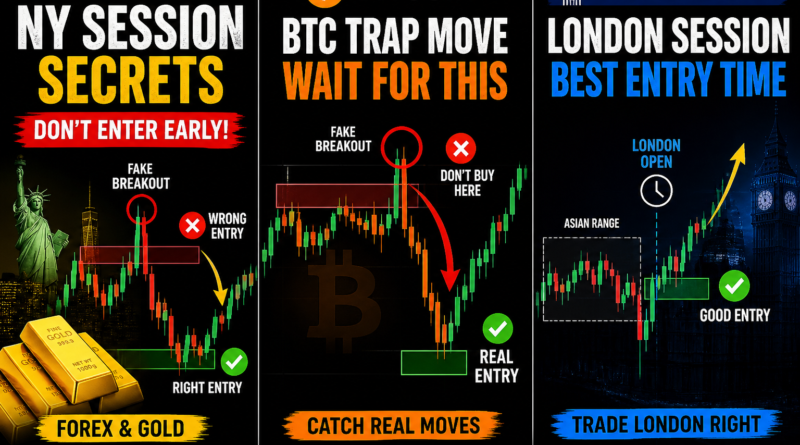
New York Session Trading Guide – How to Catch Real Moves in Forex & Gold (Without Overtrading)
The New York trading session is one of the most important parts of the Forex market. It is where many strong moves in Forex pairs and Gold (XAUUSD) happen.
But here’s the problem:
Most traders still lose money during this session.
Not because there are no opportunities, but because they overtrade, enter too early, or trade without patience.
In this guide, I’ll explain how I personally approach the New York session in a simple and structured way.
What You Will Learn
- What the New York session is
- When the best moves usually happen
- How to plan entries properly
- When it’s better not to trade
- Common mistakes traders make
What the New York Session Really Is
The New York session is the period when US markets become active.
During this time:
- US traders enter the market
- Important economic news is released
- Price movement often increases
- Trends either continue or reverse
For Gold (XAUUSD), this session is especially important because volatility is usually higher compared to other parts of the day.
However, this also means fake moves can happen.
So the goal is not to trade more, the goal is to trade at the right time. Why 90% of Traders Fail Prop Firm Challenges (Risk Management Explained)
How I Trade the New York Session (Step-by-Step)
Step 1: Check the London Session First
Before New York opens, I always check what happened during London.
- If London is trending → I look for continuation
- If London is choppy → I expect manipulation or fake moves
This helps me understand market context.
Step 2: Mark Key Levels
Before New York begins, I mark important levels such as:
- London high and low
- Previous day high and low
- Liquidity zones
These levels help me understand where price may react.
Step 3: Wait for the New York Open Reaction
I do not enter trades immediately when the session starts.
Instead, I wait and observe:
- Does price sweep liquidity?
- Is there a false breakout?
- How does price react around key levels?
This step is very important for avoiding early traps.
Step 4: Wait for Confirmation
I only enter a trade after confirmation.
This can include:
- Clear rejection from a level
- Market structure shift
- Strong momentum candles
If none of these appear, I skip the trade.
Step 5: Enter Only When the Setup Is Clear
If everything aligns, I take the trade.
If the market looks unclear or messy, I simply do not trade. Liquidity Sweep + FVG Strategy: A High-Probability SMC Entry Model (Simple Price Action Guide)
Important Trading Logic Most Traders Ignore
Many traders make the same mistake:
They think New York session automatically means “trade every move.”
That is not true.
Sometimes:
- Price is already extended
- Liquidity is unclear
- Market is slow or messy
In these situations, staying out is often the best decision.
A common pattern in New York is:
- First move → fake
- Second move → real direction
Traders who enter too early often get trapped in the first move. How to Trade Break and Retest Without Getting Faked Out (Simple Price Action Guide)
Simple Example
Let’s say:
Price breaks above the London high.
At first, it looks like a strong bullish breakout.
But then price quickly falls back below that level.
This is often a liquidity grab.
After that, if bearish confirmation appears, that becomes a better opportunity than the initial breakout.
Many beginners lose money because they chase the first move.
Common Mistakes in New York Session Trading
- Entering immediately after session opens
- Chasing breakouts without confirmation
- Ignoring London session structure
- Overtrading every movement
- Not waiting for clear setups
Simple Rules to Follow
- Always check London session first
- Wait for liquidity sweep
- Never enter immediately at open
- Trade confirmation, not prediction
- Focus on risk management
Final Thoughts
The New York session offers strong trading opportunities, but only when approached with patience and structure.
Most traders struggle not because the market is bad, but because they rush decisions.
You don’t need more trades.
You need better timing and discipline.
Disclaimer
Disclaimer: Trading forex and CFDs involves significant risk and may not be suitable for all investors. This article is for educational purposes only and should not be considered financial advice.
Written by Shah – Forex trader and market analyst at Forex News 360.
This is best for new traders :

Pingback: Kill Zones in Forex: Smart Money Timing Strategy for Better Entries
Pingback: Best Time to Trade XAUUSD (Gold) for Maximum Volatility
Pingback: Moving Averages (EMA vs SMA) Explained | Forex & Crypto Trading Guide
Pingback: Candlestick Patterns: How to Read Candlestick Charts (Beginner Guide)
Pingback: The Compound Effect: Why Consistency in Trading Matters More Than Big Wins
Pingback: Gold Price Analysis: XAU/USD Remains Under Strong Selling Pressure as Bears Control the Market